
Learning numbers is one of the easiest ways to start building confidence in American Sign Language (ASL). Numbers appear everywhere in everyday communication—from telling your age and giving a phone number to talking about money, dates, addresses, scores, and quantities.
If you are searching for numbers in sign language, ASL numbers 1–10, or how to count from 0 to 10 in sign language, this guide shows each number individually with a clear description of the handshape and position.
The images in this guide can be placed directly with their matching number sections. Since ASL is a visual language, looking at the handshape while reading the instructions makes learning much easier.
Important: “Sign language” is not one universal language. The instructions below are for American Sign Language (ASL). Other sign languages, such as British Sign Language (BSL), French Sign Language (LSF), Spanish Sign Language, and others, use different signs for numbers.
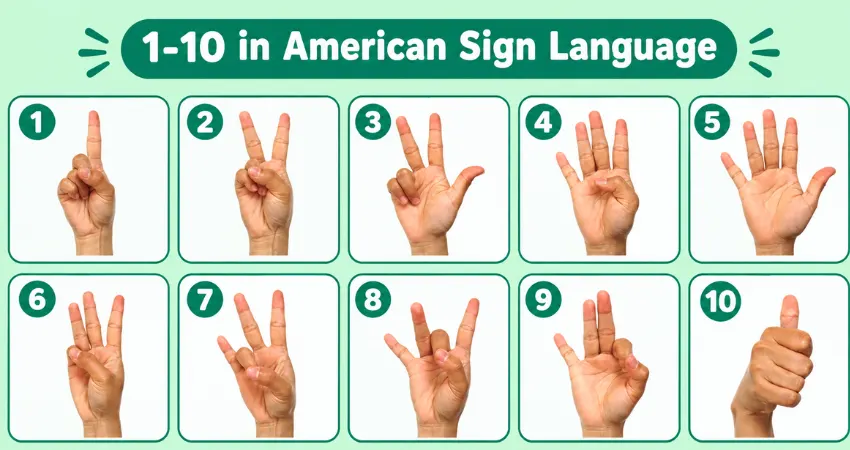
ASL Numbers 0–10 at a Glance
These basic signs are a useful starting point for learning how numbers are represented in ASL. The exact appearance of your hand can vary slightly depending on hand size, viewing angle, and signing style, but the basic handshapes remain important.
0 in American Sign Language
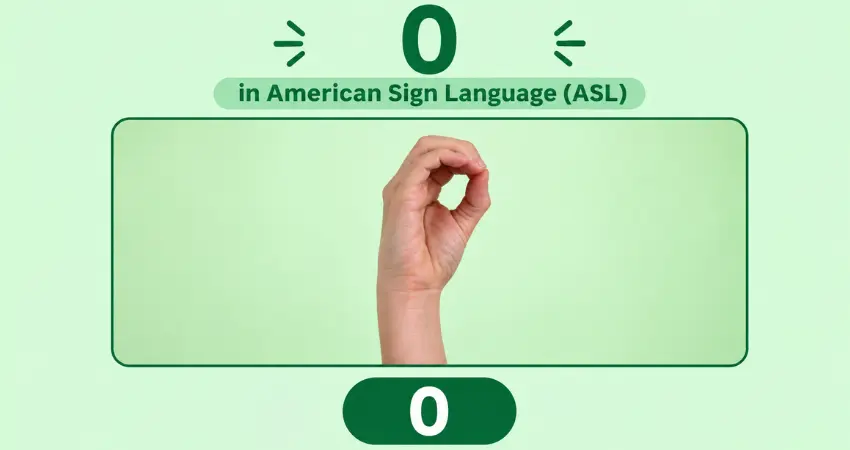
The ASL sign for 0 is based on the shape of the letter O.
How to sign 0
Start with your dominant hand open.
Bring your fingertips toward your thumb.
Touch the fingertips to the thumb so they form a rounded O shape.
Keep the hand relatively still.
The resulting handshape looks similar to a zero or the letter O.
What to remember
Think “O for zero.” The important part is creating a clear circular handshape with the thumb and fingertips.
When practicing, make sure the fingers are comfortably curved rather than tightly squeezed together. A relaxed hand usually makes the shape easier to recognize.
0 in ASL
Handshape: O
Movement: Usually none
Position: In front of the body
Main idea: Form an O with the hand
1 in American Sign Language
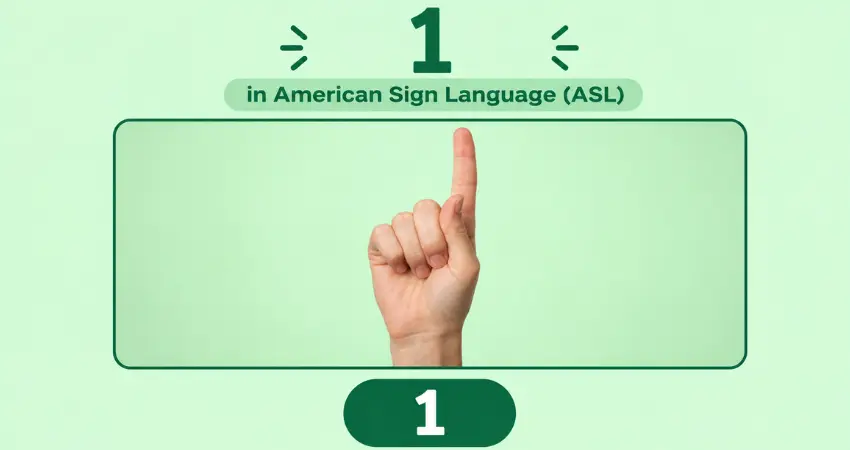
The ASL sign for 1 is simple and is often one of the first number signs beginners learn.
How to sign 1
Hold your dominant hand upright.
Curl your thumb, middle, ring, and pinky fingers into your palm.
Extend your index finger straight upward.
Keep the index finger relaxed but clearly extended.
The hand should look similar to a raised index finger.
1 in ASL
Handshape: Index finger extended
Other fingers: Folded into the palm
Movement: None for the basic number
Position: Upright in front of the body
Practice tip
Do not accidentally extend the middle finger along with the index finger. For the number 1, only the index finger should be raised.
2 in American Sign Language
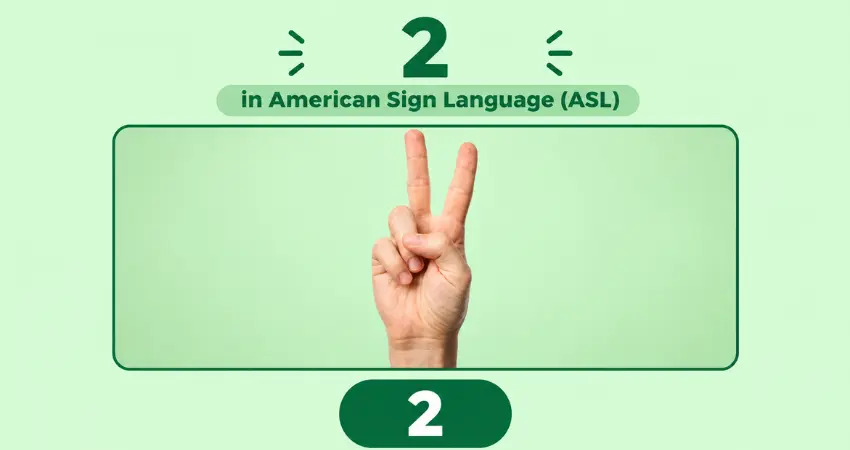
The ASL sign for 2 uses two extended fingers.
How to sign 2
Hold your dominant hand upright.
Fold your thumb, ring finger, and pinky into your palm.
Extend your index and middle fingers upward.
Keep the two fingers separated naturally.
Your hand should resemble the familiar “V” shape, although ASL signing is about the specific handshape rather than simply making a gesture associated with the number.
The image you provided shows this basic ASL number 2 handshape clearly.
2 in ASL
Handshape: Index and middle fingers extended
Other fingers: Folded
Movement: None for the basic number
Position: Upright in front of the body
Common mistake
Make sure the thumb stays folded rather than extending outward. Extending an extra finger changes the handshape.
3 in American Sign Language
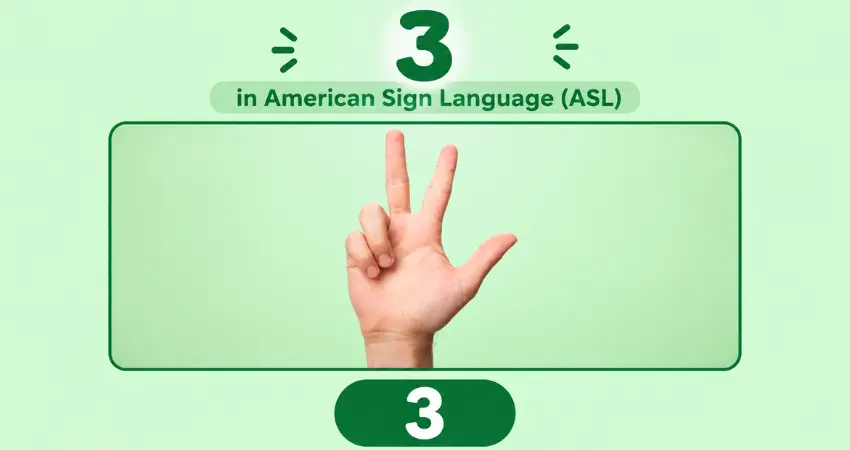
The ASL sign for 3 is different from simply holding up three fingers in some everyday gestures.
How to sign 3
Hold your dominant hand upright.
Extend your thumb, index finger, and middle finger.
Fold your ring finger and pinky toward your palm.
Keep the three extended fingers clearly separated.
The thumb is an important part of this handshape. This is one reason beginners should look carefully at an ASL reference image rather than relying only on the number of fingers they see.
3 in ASL
Extended fingers: Thumb, index, middle
Folded fingers: Ring and pinky
Movement: None for the basic number
Position: Upright in front of the body
Practice tip
Say “three” silently while forming the handshape. Check that your thumb is extended and your ring finger and pinky remain folded.
4 in American Sign Language
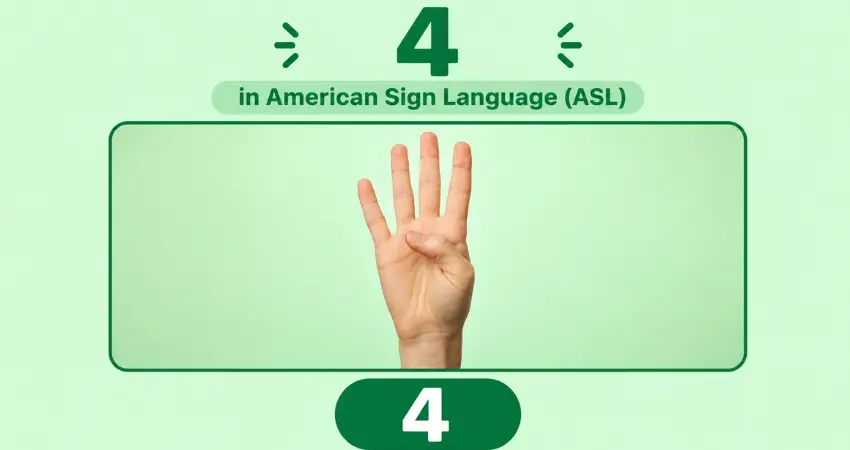
The ASL number 4 uses four extended fingers while the thumb remains folded.
How to sign 4
Hold your dominant hand upright.
Extend your index, middle, ring, and pinky fingers.
Keep your thumb folded across your palm.
Hold the four fingers upright and reasonably close together.
This creates a clear four-finger handshape.
4 in ASL
Extended fingers: Index, middle, ring, pinky
Folded finger: Thumb
Movement: None for the basic number
Position: Upright in front of the body
Watch your thumb
A common beginner mistake is allowing the thumb to stick out. For the basic ASL number 4, the thumb should remain folded.
5 in American Sign Language
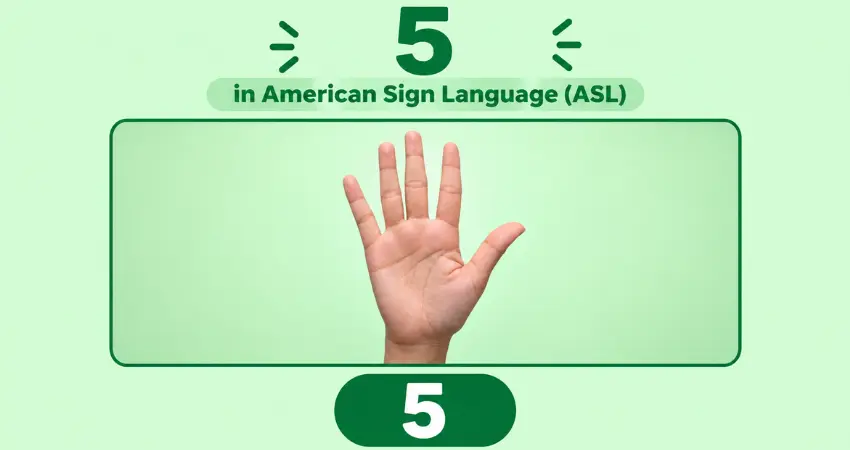
The number 5 is one of the most recognizable ASL number signs.
How to sign 5
Open your dominant hand.
Extend all five fingers.
Spread the fingers naturally.
Keep the palm facing outward in the basic number form.
There is no special movement needed for the standalone number 5.
5 in ASL
Handshape: Open five-hand
Fingers: All five extended
Movement: None for the basic number
Position: Upright in front of the body
Practice tip
Relax your fingers instead of spreading them as widely as possible. The goal is a clear open hand, not an exaggerated stretch.
6 in American Sign Language
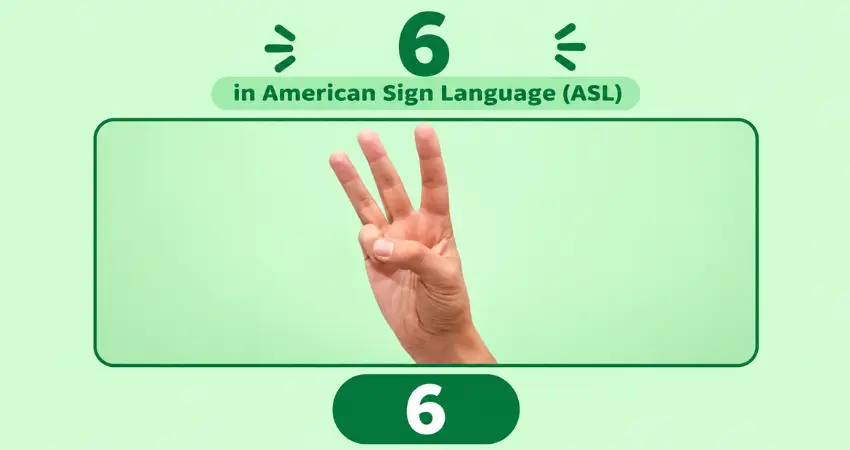
Starting with 6, ASL numbers become especially useful for learning how thumb contact changes the handshape.
How to sign 6
Start with an open hand.
Keep your index, middle, ring, and pinky fingers extended.
Bring the thumb to the pinky.
Touch the thumb and pinky together while keeping the other fingers extended.
The thumb-to-pinky contact is the key feature of the ASL number 6.
6 in ASL
Thumb touches: Pinky
Other fingers: Extended
Movement: Usually none for the standalone number
Position: In front of the body
Easy way to remember 6
Think:
6 = thumb + pinky
Once you understand this pattern, the next three numbers become easier to learn.
7 in American Sign Language
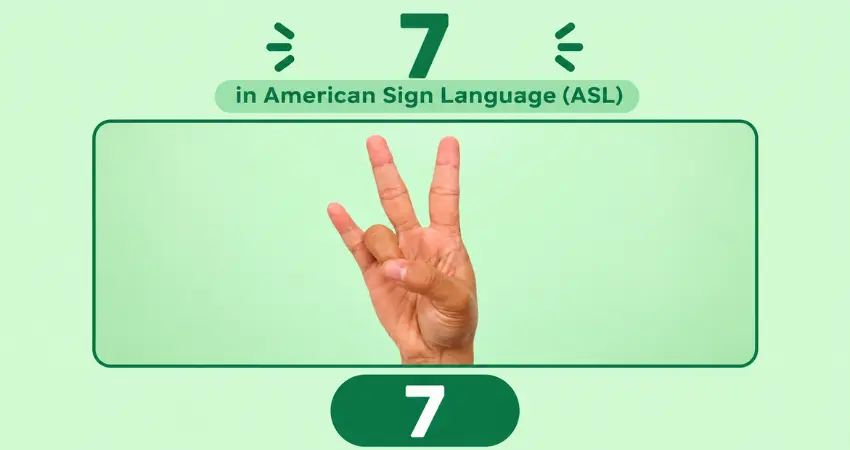
The ASL number 7 uses a similar handshape to 6, but the thumb touches a different finger.
How to sign 7
Begin with an open hand.
Keep the fingers extended.
Bring your thumb inward.
Touch the thumb to the ring finger.
Keep the remaining fingers extended.
7 in ASL
Thumb touches: Ring finger
Other fingers: Extended
Movement: None for the basic number
Position: In front of the body
Easy way to remember 7
Remember the sequence:
6 → pinky
7 → ring finger
The contact point moves one finger inward.
8 in American Sign Language
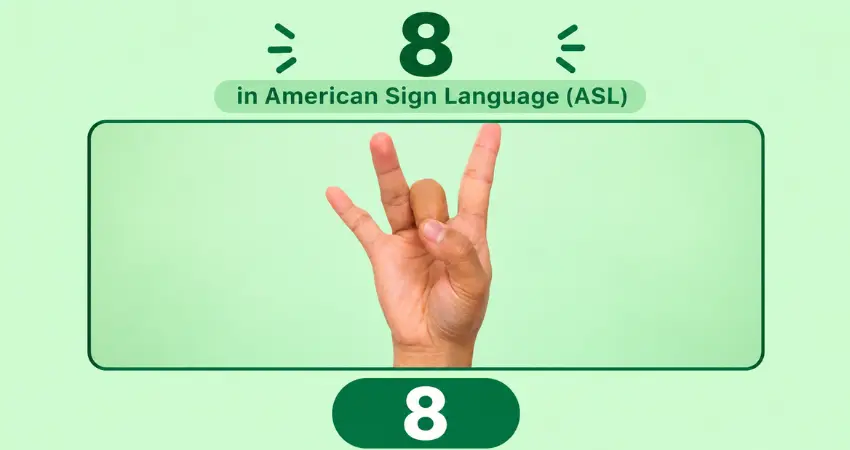
The number 8 continues the same thumb-contact pattern.
How to sign 8
Hold your dominant hand open.
Keep your fingers extended.
Move the thumb toward the middle finger.
Touch the thumb to the middle finger.
Keep the remaining fingers extended.
8 in ASL
Thumb touches: Middle finger
Other fingers: Extended
Movement: None for the basic number
Position: In front of the body
Easy way to remember 8
Think of the progression:
6 = pinky
7 = ring finger
8 = middle finger
The thumb is moving inward across the hand.
9 in American Sign Language
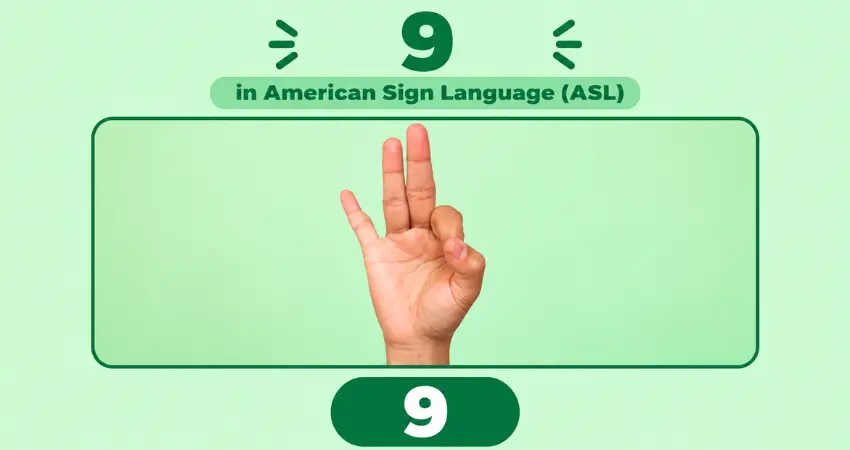
The ASL number 9 completes this thumb-contact sequence.
How to sign 9
Start with your dominant hand open.
Keep your fingers extended.
Bring your thumb toward your index finger.
Touch the thumb to the index finger.
Keep the other fingers extended.
9 in ASL
Thumb touches: Index finger
Other fingers: Extended
Movement: None for the basic number
Position: In front of the body
Easy way to remember 9
The sequence is:
6 → pinky
7 → ring
8 → middle
9 → index
This makes 6–9 much easier to memorize as one group instead of four unrelated signs.
10 in American Sign Language
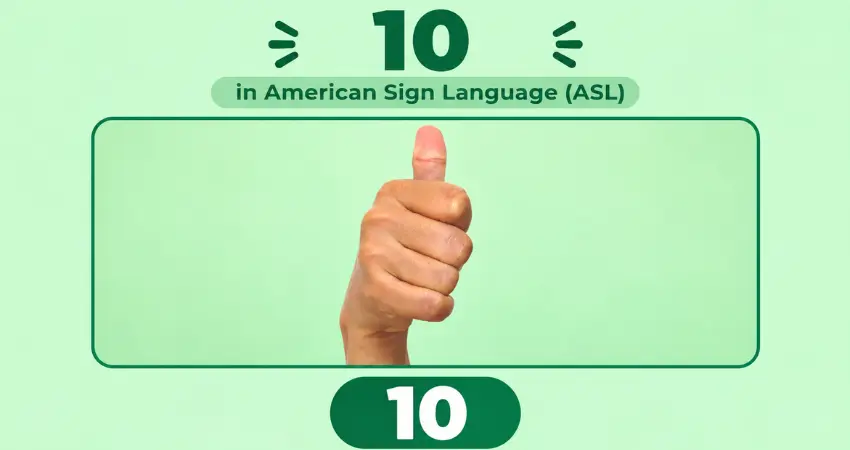
The number 10 is different from 6–9.
Instead of touching the thumb to one of the fingers, the basic ASL sign for 10 uses a closed A-like handshape with the thumb extended.
How to sign 10
Make a fist with your dominant hand.
Keep your thumb extended along the side of the fingers.
Hold the hand upright.
Make a small twisting or shaking movement of the wrist.
The movement helps distinguish the standalone ASL number 10 from a static handshape.
10 in ASL
Handshape: A-like closed hand
Thumb: Extended
Movement: Small side-to-side wrist movement
Position: In front of the body
Practice tip
Do not simply hold up a closed fist and call it 10. The movement is part of the commonly used standalone ASL sign for 10.
How to Remember ASL Numbers 0–10
Trying to memorize eleven signs separately can feel harder than it needs to be. A better approach is to group them by their handshapes.
Group 1: 0–5
The first group includes:
0 → O shape
1 → Index finger
2 → Index + middle
3 → Thumb + index + middle
4 → Four fingers
5 → Open hand
Practice these slowly until you can move from one number to the next without looking at your hand.
Group 2: 6–9
Numbers 6 through 9 follow a particularly useful pattern:
6: Thumb touches pinky
7: Thumb touches ring finger
8: Thumb touches middle finger
9: Thumb touches index finger
The thumb moves progressively across the hand.
Group 3: 10
10 has its own handshape and movement, so learn it separately rather than trying to force it into the 6–9 pattern.
ASL Numbers 1–10 vs. Counting in Sign Language
A useful distinction for beginners is that showing a number and using numbers in a sentence are not always exactly the same learning task.
For example, you might practice individual numbers by signing:
1, 2, 3, 4, 5, 6, 7, 8, 9, 10
But natural ASL communication can involve additional considerations such as number type, context, repetition, movement, and the way a number is incorporated into a larger expression.
Learning the standalone number signs first gives you a foundation. Once those handshapes are familiar, you can move on to more advanced topics such as ages, money, dates, clock numbers, phone numbers, addresses, and larger numbers.
Are ASL Numbers the Same as English Numbers?
No. ASL is a complete natural language with its own grammar and linguistic structure. It is not simply English represented with the hands.
The basic ASL number signs correspond to numerical concepts, but using numbers naturally in ASL requires understanding the context in which they occur.
This is important when learning from online resources. A picture showing a handshape can teach you what the sign looks like, but it does not by itself teach the grammar of ASL.
Why Visual Practice Matters When Learning Numbers
Numbers are particularly suitable for visual learning because small differences in finger position can change the meaning.
For example:
1 has one raised finger.
2 has two raised fingers.
3 includes the thumb.
4 keeps the thumb folded.
5 opens the entire hand.
6–9 depend on which finger touches the thumb.
That means simply reading a written description is not enough for many beginners.
Use the images alongside the instructions and compare your hand with the reference after forming each number.
Common Mistakes When Learning ASL Numbers 0–10
1. Counting fingers without checking the handshape
ASL numbers are not always just “hold up this many fingers.” Numbers such as 3, 6, 7, 8, and 9 have specific handshapes.
2. Extending the wrong finger
For 1, only the index finger should be extended.
For 2, the index and middle fingers are extended.
For 3, the thumb, index, and middle fingers are extended.
3. Forgetting the thumb in 6–9
The contact between the thumb and a particular finger is an important part of these number signs.
4. Confusing 4 and 5
The difference is straightforward:
4: Four fingers extended, thumb folded.
5: All five fingers extended.
5. Treating every sign language as ASL
ASL is used primarily in the United States and parts of Canada, but it is not the universal sign language. If you are learning another country's sign language, its number signs may be different.
How to Practice Numbers 0–10 in ASL
A short daily practice session of sign language alphabet can be more useful than trying to memorize everything at once.
Step 1: Learn 0–5
Practice:
0 → 1 → 2 → 3 → 4 → 5
Repeat the sequence several times.
Step 2: Learn 6–9 as a pattern
Instead of memorizing them individually, watch the thumb:
6 → pinky
7 → ring
8 → middle
9 → index
Step 3: Add 10
Practice the number 10 separately until the handshape and movement feel natural.
Step 4: Practice in random order
Ask yourself:
What is 7?
What is 3?
What is 9?
What is 1?
What is 6?
Random practice helps prevent you from simply remembering the sequence.
Step 5: Practice without looking at the written number
Look at an ASL number image and identify the number before checking the answer. This trains your visual recognition skills.
Numbers 0–10 in Sign Language: Quick Reference
Here is a simple reference you can return to while practicing:
0: Make an O-shaped hand.
1: Raise the index finger.
2: Raise the index and middle fingers.
3: Raise the thumb, index, and middle fingers.
4: Raise four fingers with the thumb folded.
5: Open all five fingers.
6: Touch the thumb to the pinky.
7: Touch the thumb to the ring finger.
8: Touch the thumb to the middle finger.
9: Touch the thumb to the index finger.
10: Make an A-like closed hand with the thumb extended and use a small twisting/shaking movement.
Frequently Asked Questions
What is 1 in sign language?
In American Sign Language (ASL), the number 1 is made by extending the index finger upward while keeping the other fingers folded into the palm.
How do you sign 2 in ASL?
Raise your index and middle fingers while keeping your thumb, ring finger, and pinky folded. Hold the hand upright.
How do you sign 3 in ASL?
Extend the thumb, index finger, and middle finger while keeping the ring finger and pinky folded.
How do you sign 4 in ASL?
Extend your index, middle, ring, and pinky fingers while keeping your thumb folded.
How do you sign 5 in ASL?
Open your hand and extend all five fingers naturally.
How do you sign 6 in ASL?
Touch your thumb to your pinky while keeping the other fingers extended.
How do you sign 7 in ASL?
Touch your thumb to your ring finger while keeping the other fingers extended.
How do you sign 8 in ASL?
Touch your thumb to your middle finger while keeping the other fingers extended.
How do you sign 9 in ASL?
Touch your thumb to your index finger while keeping the other fingers extended.
How do you sign 10 in ASL?
Make an A-like closed hand with the thumb extended and add the small twisting/shaking movement used for the standalone number 10.
Is ASL the same as sign language?
No. There are many sign languages around the world. ASL is a specific natural sign language used primarily in the United States and parts of Canada. British Sign Language, French Sign Language, Spanish Sign Language, and other sign languages have their own vocabulary and grammar.
Can I learn ASL numbers without learning the whole language?
Yes. You can learn the numbers 0–10 as a starting point. However, knowing the individual number signs is only one part of learning ASL. To communicate naturally, you will eventually need to learn vocabulary, grammar, facial expressions, body movement, and conversational context.
Learn More Sign Language With Visual Practice
Numbers are a useful first step because they help beginners become familiar with ASL handshapes and visual communication. Once you can recognize 0 through 10, continue with larger numbers and everyday signs such as greetings, family words, common objects, colors, food, and basic phrases.
Final Thoughts
Learning numbers 0–10 in American Sign Language does not have to be difficult. Start with the basic handshapes, pay attention to the thumb and finger positions, and practice the signs visually rather than relying only on written descriptions.
The most useful pattern to remember is 6–9: the thumb moves from the pinky to the ring finger, middle finger, and index finger. Numbers 1–5 become easier when you focus on which fingers are extended, while 10 requires its own handshape and movement.
Practice 0–10 every day, test yourself in random order, and use clear reference images while learning. With repetition, these basic ASL numbers can become a natural foundation for learning larger numbers and everyday American Sign Language.