
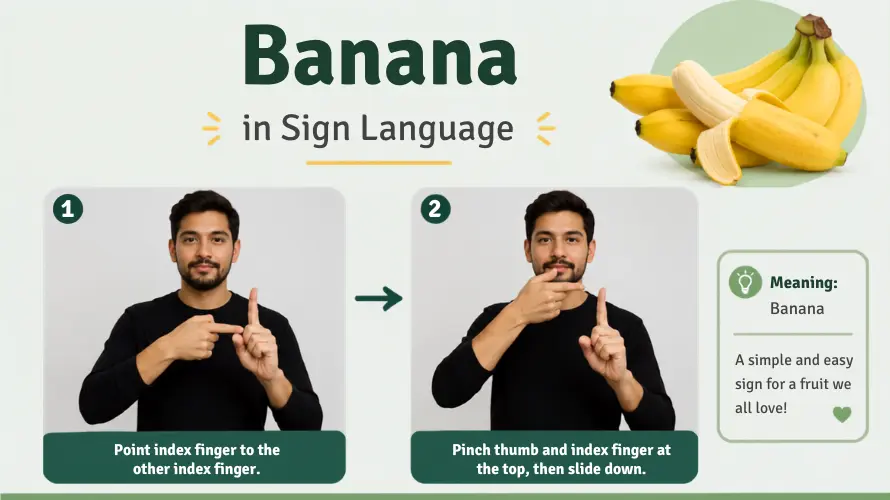
To sign “banana” in ASL: point your non-dominant index finger straight up like a fist with one finger raised. With your dominant hand, pinch your thumb and index finger together at the top of that finger and slide down — as if peeling it — then repeat the motion on the other side.
The 3-step breakdown
Click through each step below. The illustration mirrors what your hands should be doing at that moment.
1. Make the “banana” finger
Fist with your non-dominant hand, index finger pointing straight up, palm facing you.
2. Pinch the peel
Touch thumb and index finger together on your dominant hand, resting at the top.
3. Peel down, then repeat
Slide down one side, return to the top, then peel down the other side.
Non-dominant hand · “1” handshape
02. Two hands, two jobs
Every sign splits work between a base hand and an active hand. Banana is a clean example of that division.
Non-dominant hand
The “1” handshape
Held still. Fingers curl into a loose fist while the index finger stays straight and upright — this finger stands in for the whole banana.
Dominant hand
The pinch (flat-O)
Does all the movement. Thumb and index finger meet in a light pinch and slide downward twice — once per side — tracing the peel.
03. Common mistakes
Small handshape slips are the usual culprit — none of these ruin the sign, but fixing them makes it read more naturally.
✕ Peeling only one side
The sign needs both sides peeled — a single downward stroke reads as incomplete to fluent signers.
✕ Keeping the base fist loose
If the other fingers stay open instead of curled, the handshape drifts toward a different sign entirely.
✕ Pinching too high above the finger
The peeling hand should stay in light contact with the index finger, not hover above it.
04. Practice it
Muscle memory beats reading about it. Do the full peeling motion — both sides — and log each rep.
Repeat the sign 5 times
Hold your non-dominant fist up, index finger extended, and peel down both sides with your dominant hand. Tap the button after each full rep.
Using it in a sentence
ASL grammar doesn’t map word-for-word onto English. Here’s a natural gloss for a common request.
English
“I want a banana.”
ASL gloss
BANANAWANTME
Topic-comment order — the object often leads, followed by the verb, with the subject implied or placed last.
How to Learn Sign Language Completely?
Learning sign language completely takes regular practice, patience, and real-world communication. Start by learning the sign language alphabet, common words, and basic grammar, then practice daily with videos, classes, or native signers. A sign language translator can also help you understand signs, visualize hand shapes, and reinforce what you learn, making practice easier and more interactive.
7. Frequently asked questions
Is the sign for banana the same in every sign language?+
No. ASL uses a peeling motion against the index finger. British Sign Language (BSL) and other national sign languages often use a different handshape or peeling direction, since most sign languages developed independently of one another rather than from a shared source.
Which hand should be the “banana” finger?
Your non-dominant hand holds the index finger up to represent the banana, while your dominant hand does the peeling motion. Left-handed signers simply mirror the whole sign.
Is this the same sign babies and toddlers use?
Yes. Baby sign language programs teach this same peeling motion, since it’s visual and easy for small hands to approximate. An early attempt that only loosely resembles the movement is completely normal.
Do I peel one side or both sides of the finger?
Both. Peel down one side of the index finger first, then return to the top and peel down the other side, mirroring how a real banana peel is opened in sections.
Can I fingerspell “banana” instead?
You can fingerspell B-A-N-A-N-A and be understood, but the dedicated sign is far more natural and is what fluent signers use in everyday conversation.