
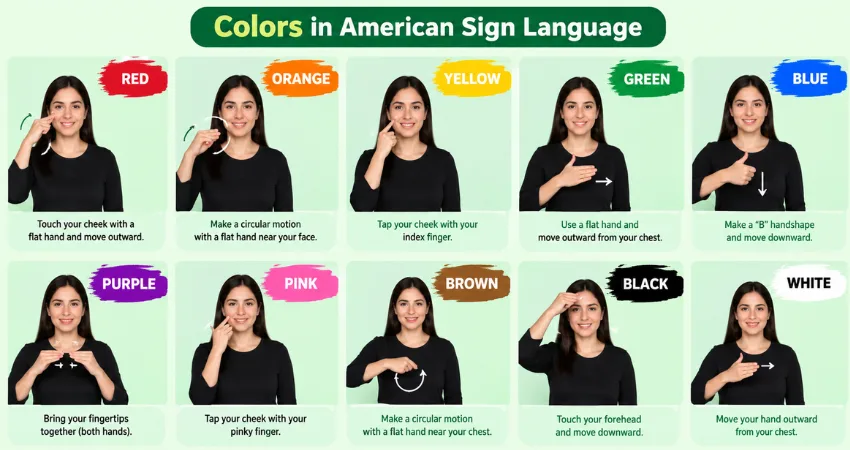
Learning colors in sign language is a practical way to build everyday communication skills. Colors come up when you describe clothes, objects, food, cars, flowers, animals, drawings, and almost anything you can see around you. If you are learning American Sign Language (ASL), knowing the signs for common colors can also help you start forming simple descriptions and conversations.
In this guide, you will learn how to sign red, yellow, green, pink, black, white, gold, silver, gray, dark, light, blue, purple, brown, and orange in American Sign Language. Each section explains the handshape and movement in simple terms, making it easier to practice alongside the images on this page.
Important: Sign languages are not universal. The signs below refer primarily to American Sign Language (ASL). Other sign languages may use completely different signs for the same color.
Colors in Sign Language
Here are the common ASL signs covered in this guide:
Red
Yellow
Green
Pink
Black
White
Gold
Silver
Gray
Dark
Light
Blue
Purple
Brown
Orange
The easiest way to learn these signs is to study the handshape first, then copy the movement shown in the image. Practice each sign several times until the handshape and motion feel natural.
Red in Sign Language
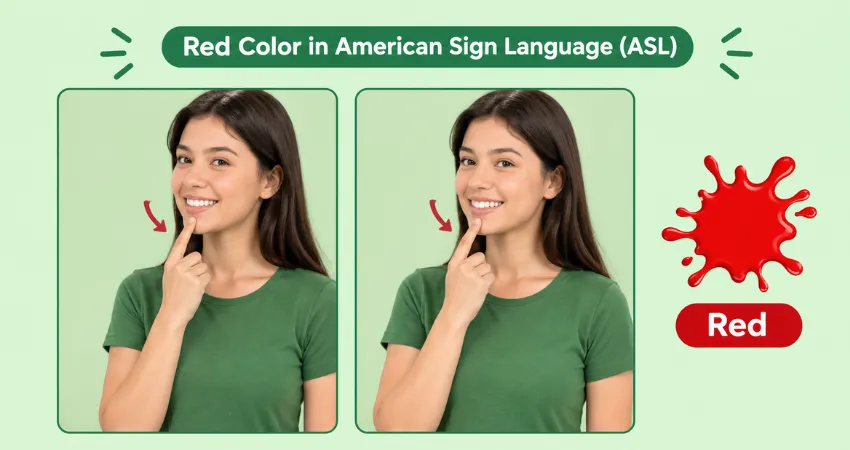
To sign red in ASL, use your dominant hand with the index finger extended while the other fingers are closed. Touch the tip of your index finger to your lower lip and move it downward along the lip.
The movement is short and controlled. Keep the rest of your hand relaxed while concentrating on the index finger.
How to sign red:
Make a handshape with your index finger extended.
Place the fingertip near your lower lip.
Move the index finger downward along the lower lip.
Repeat the movement naturally if needed.
The sign is easy to remember because the movement takes place directly around the lips.
Example: You can use the sign for red when describing a red shirt, red car, red apple, or red flower.
Yellow in Sign Language
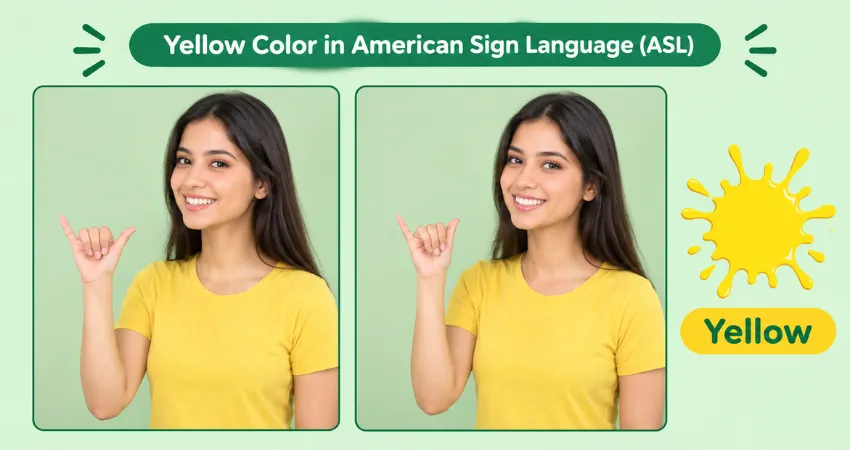
The ASL sign for yellow uses the same basic handshape as the ASL letter Y.
Hold your dominant hand with your thumb and little finger extended while the middle three fingers remain folded. Move the hand slightly from side to side.
How to sign yellow:
Make the ASL letter Y handshape.
Keep your thumb and pinky extended.
Hold the hand in front of your body.
Move it gently from side to side.
The movement should be comfortable rather than exaggerated.
Example: If you want to describe a yellow banana, yellow flower, or yellow shirt, you can use the sign for yellow along with the appropriate noun.
Green in Sign Language
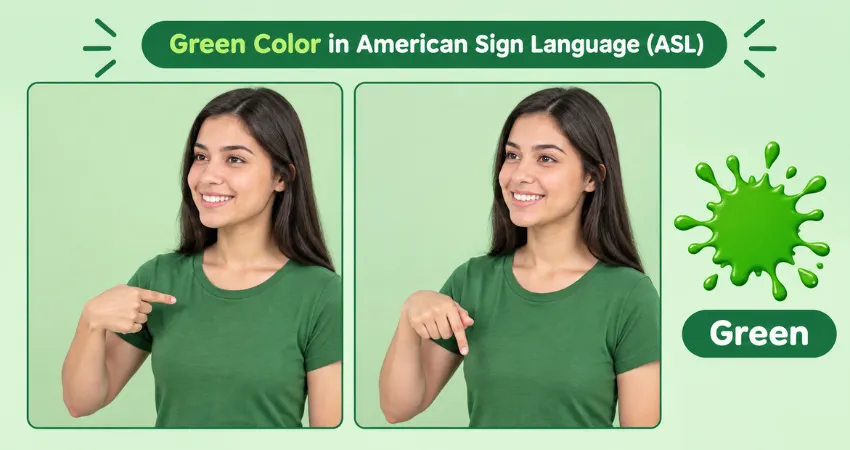
The ASL sign for green is also based on the Y handshape.
Make a Y with your dominant hand and move it gently back and forth. The hand stays in front of the body while the wrist and hand provide the movement.
How to sign green:
Form the ASL letter Y.
Extend the thumb and little finger.
Keep the other fingers folded.
Move the hand from side to side.
The sign is similar in movement to several other color signs, so paying attention to the handshape is important.
Pink in Sign Language
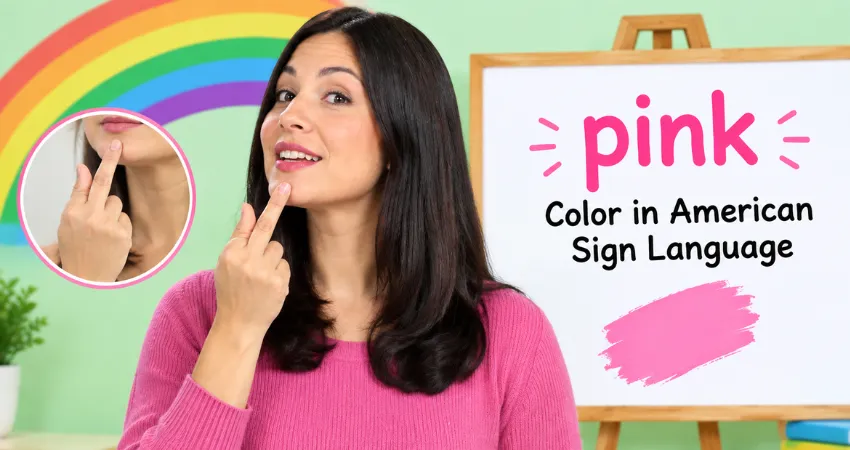
The sign for pink is related to the ASL sign for red. Start with an index-finger handshape and place the fingertip against the lower part of your lips.
Instead of simply moving the finger down once as in red, the movement for pink is repeated.
How to sign pink:
Extend your index finger.
Bring the fingertip toward your lower lip.
Move the finger downward.
Repeat the downward movement.
Because pink and red are related signs, watching the movement carefully can help you tell them apart.
Example: Use the sign when describing pink flowers, pink clothing, or a pink object.
Black in Sign Language
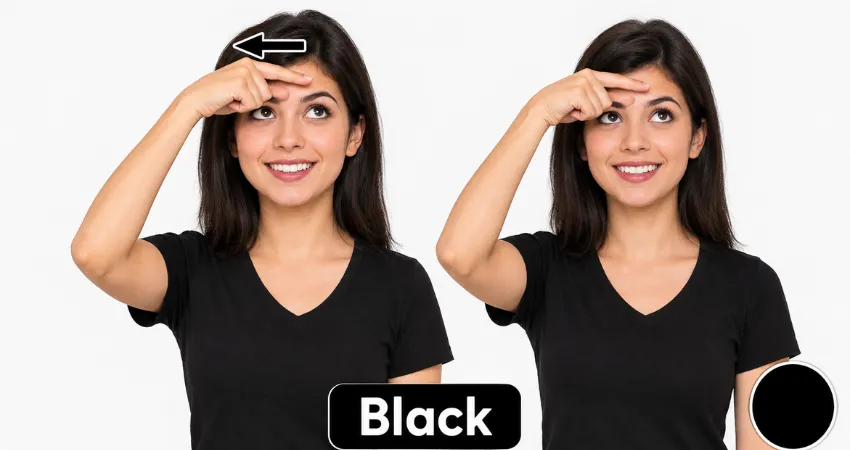
To sign black in ASL, extend your dominant index finger while keeping the other fingers closed.
Start near the forehead and move the index finger horizontally across the forehead.
How to sign black:
Extend your index finger.
Place it near one side of your forehead.
Move the finger across the forehead toward the other side.
Keep the movement smooth and controlled.
The sign visually follows the area of dark hair above the forehead, which can make it easier to remember.
White in Sign Language

The ASL sign for white uses an open hand placed near the upper chest.
Start with your dominant hand near the chest and move it slightly away while closing the fingers toward the palm.
How to sign white:
Start with an open dominant hand.
Place it near the upper chest.
Pull the hand slightly away.
Close the fingers as you move.
The motion represents something being taken from the front of a shirt or chest area.
Gold in Sign Language

The ASL sign for gold is associated with the idea of something being yellow or golden and is commonly produced with a movement near the side of the face.
A common ASL form uses the Y handshape, moving it downward along the side of the face.
How to sign gold:
Make the ASL Y handshape.
Position the hand near the side of your face.
Move it downward along the cheek.
Keep the movement smooth.
When learning this sign, use the accompanying image as your primary visual reference because small differences in hand position can be difficult to describe with words alone.
Silver in Sign Language
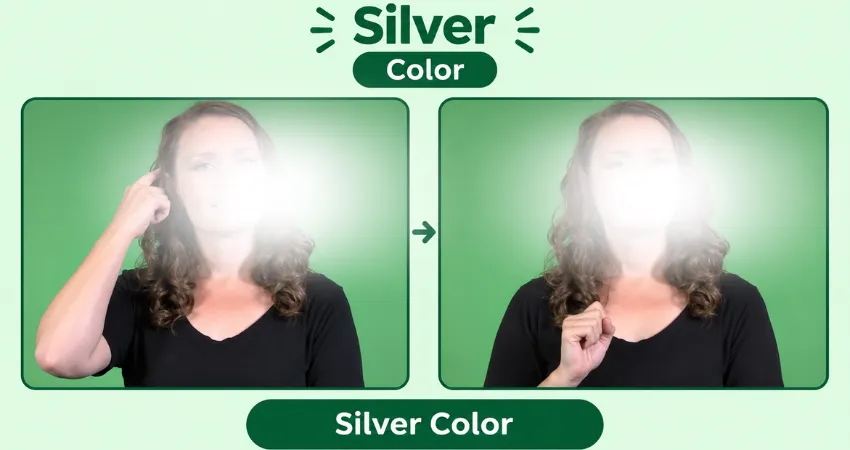
The ASL sign for silver combines a handshape and movement that relate to the idea of something shiny or metallic.
One common form uses a handshape similar to the sign for metal, followed by a movement suggesting the appearance or quality of silver.
Because color and material signs can have regional or contextual variations, learners should pay attention to the exact handshape shown in their reference image.
Practice tip: First copy the handshape, then practice the movement slowly. Once you can produce it accurately, increase your speed to a natural conversational pace.
Gray in Sign Language

To sign gray in ASL, use both hands with open fingers and bring them together or move them in a controlled alternating motion.
The hands should remain relaxed rather than stiff.
How to sign gray:
Hold both hands open.
Position them in front of your body.
Bring the hands toward each other.
Alternate or interlock the fingers as shown in the reference.
The exact finger movement is important, so learners should compare their hand position with a reliable ASL image or video while practicing.
Dark in Sign Language
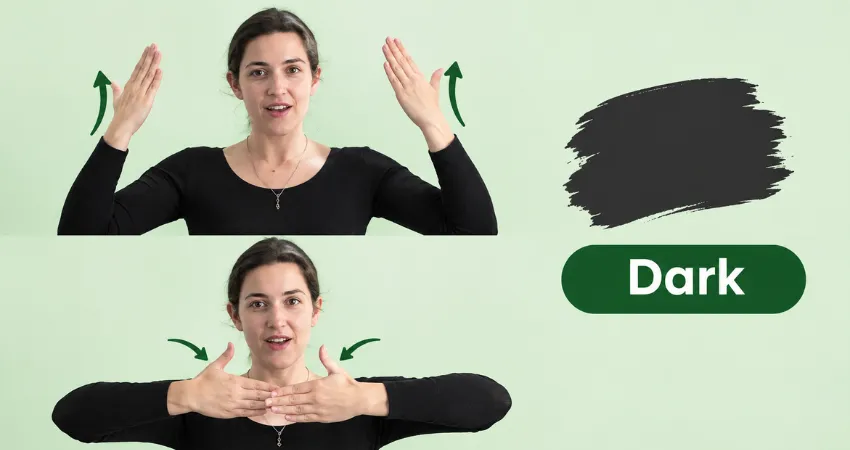
The ASL sign for dark uses both hands to represent an area becoming covered or less bright.
Hold your hands in front of your body with the palms facing downward. Move the hands downward to represent darkness coming over an area.
How to sign dark:
Hold both hands horizontally.
Keep the palms facing downward.
Start around the upper chest area.
Move both hands downward.
The movement gives the visual impression of light being covered.
Example: You can use dark when describing a dark room, dark color, dark sky, or dark clothing.
Light in Sign Language
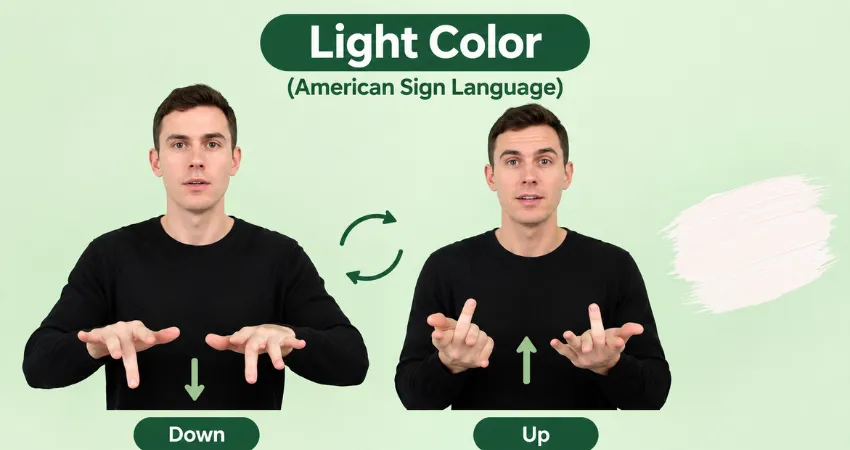
The ASL sign for light can represent illumination or brightness. The movement generally communicates the idea of light spreading or becoming visible.
Hold your hands in front of you and move them upward and outward in a way that suggests light radiating.
How to sign light:
Begin with your hands positioned in front of your body.
Keep your hands relaxed.
Move them upward and outward.
Make the motion smooth and deliberate.
Context matters because English uses the word “light” for several meanings, including illumination, weight, and color intensity. ASL may use different signs depending on what you mean.
Blue in Sign Language
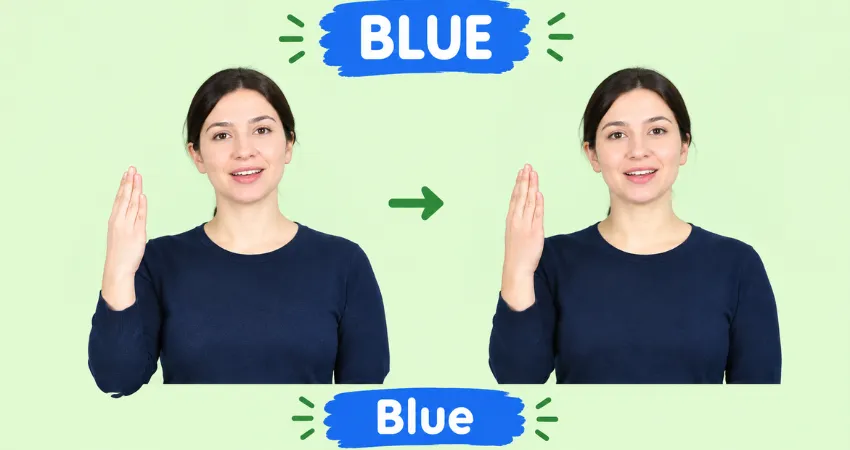
The ASL sign for blue uses the same basic handshape as the ASL letter B.
Make a B handshape with your dominant hand and move it slightly from side to side.
How to sign blue:
Extend your four fingers upward.
Keep the fingers together.
Fold your thumb across your palm.
Move the B-shaped hand gently from side to side.
The B handshape is the most important part to remember.
Example: You can use blue when describing blue eyes, a blue shirt, a blue car, or a blue sky.
Purple in Sign Language

The sign for purple uses the ASL letter P handshape.
Make the P handshape with your dominant hand and move it gently from side to side.
How to sign purple:
Form the ASL letter P.
Hold the hand in front of your body.
Move it gently from side to side.
Keep your wrist relaxed.
The movement resembles the pattern used for several other ASL color signs, so learning the letter handshape helps distinguish purple from them.
Brown in Sign Language
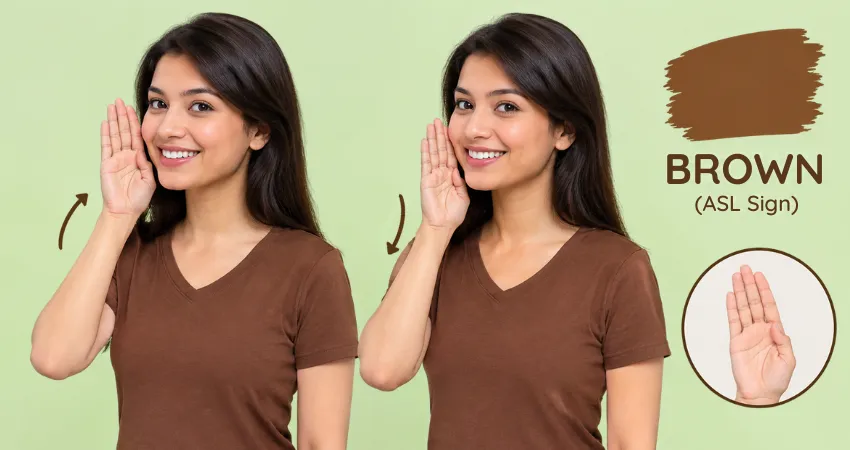
To sign brown in ASL, use the ASL letter B handshape.
Hold your dominant hand with the fingers extended and together and the thumb folded across the palm. Move the hand downward along the side of your face.
How to sign brown:
Make the B handshape.
Position your hand near the side of your face.
Move the hand downward along the cheek.
Keep the fingers together throughout the movement.
The sign is visually connected with the appearance of brown hair, which can make it easier to remember.
Orange in Sign Language
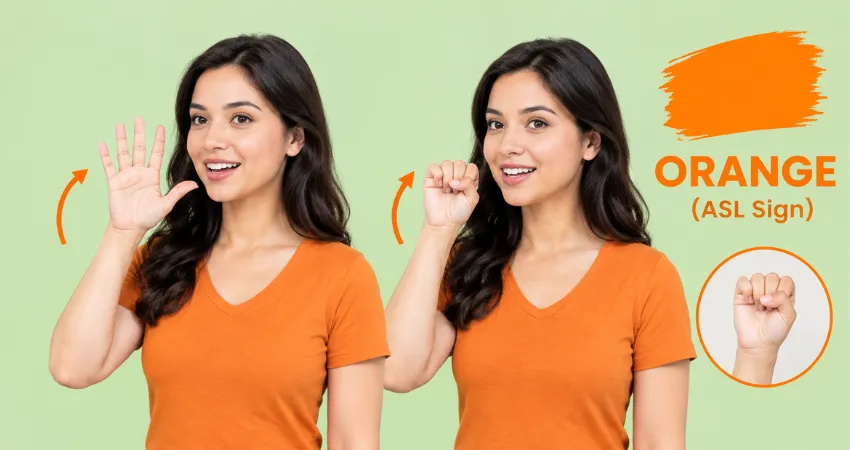
The ASL sign for orange uses a closed or curved handshape that resembles squeezing or pressing something round.
Place the hand in front of your mouth or lower face and repeatedly squeeze the fingers and thumb together.
How to sign orange:
Hold your dominant hand in a curved shape.
Place it near the lower face.
Open and close the hand as though squeezing an orange.
Repeat the movement naturally.
The squeezing motion is one of the easiest ASL color signs to associate with its meaning.
ASL Color Signs at a Glance
Color | Main handshape or movement |
|---|---|
Red | Index finger moves downward along the lower lip |
Yellow | Y handshape moving side to side |
Green | Y handshape moving side to side |
Pink | Index finger moves downward from the lower lip with a repeated motion |
Black | Index finger moves across the forehead |
White | Open hand closes while moving away from the chest |
Gold | Y handshape moves downward near the side of the face |
Silver | Handshape and movement associated with metallic silver |
Gray | Both hands move together with an alternating finger movement |
Dark | Hands move downward to represent reduced light |
Light | Hands move upward/outward to represent illumination |
Blue | B handshape moving side to side |
Purple | P handshape moving side to side |
Brown | B handshape moves downward along the side of the face |
Orange | Hand repeatedly squeezes near the mouth |
How to Learn Colors in Sign Language
Memorizing a long list of signs in one sitting can be difficult. A better approach is to learn a few colors at a time and practice them repeatedly.
Start with common colors such as red, blue, green, yellow, black, white, orange, brown, and purple. Once these become familiar, add pink, gray, gold, silver, dark, and light.
1. Learn the handshape first
Before worrying about speed, make sure your fingers are in the correct position. A small change in handshape can change an ASL sign.
2. Practice the movement slowly
Perform each sign slowly at first. This allows you to see whether your fingers, wrist, and arm are moving correctly.
3. Use pictures and videos
A written description cannot show every detail of a three-dimensional hand movement. Use clear images and, when possible, video examples to check your position.
4. Practice with real objects
Choose objects around you and sign their colors.
For example:
Red apple
Blue shirt
Green leaf
Yellow banana
Black shoes
White paper
Orange fruit
Brown table
This makes the signs easier to remember because you connect the movement with something you can actually see.
5. Practice with another person
Try signing a color while another person identifies it. Then switch roles. This turns memorization into an active communication exercise.
How Do You Sign Colors in ASL?
There is no single movement used for every color in ASL. Different colors use different handshapes and movements.
For example, blue uses a B handshape, while purple uses a P handshape. Yellow and green use a Y handshape, while brown uses a B handshape with a different movement. Learning the handshape and movement together is therefore more useful than trying to memorize color names alone.
The images on this page can help you compare the signs visually and practice each one.
Are Color Signs the Same in Every Sign Language?
No. Sign language is not universal.
American Sign Language is used primarily in the United States and parts of Canada, but other countries have their own sign languages. For example, British Sign Language (BSL), French Sign Language (LSF), Spanish Sign Language (LSE), German Sign Language (DGS), and Japanese Sign Language (JSL) have their own vocabulary and grammar.
Even when two sign languages use the same spoken-language color name in English translation, their signs may be completely different.
That is why it is important to identify the sign language you are learning before practicing a sign.
Can You Use ASL Color Signs in a Sentence?
Yes. Colors can be used naturally when describing people, objects, clothing, animals, and surroundings.
For example, if you are describing a shirt, you might communicate the idea of shirt + blue. ASL does not simply copy English word-for-word, so learners should study ASL grammar rather than assuming that every English sentence can be translated directly into the same word order.
If you are a beginner, start by learning individual color signs. Then gradually combine them with signs you already know.
Learn More Sign Language With SLTranslator
Learning individual signs is a useful starting point, but regular practice is what helps build recognition and confidence. SLTranslator provides online tools and visual resources that can help learners explore sign-language words, letters, and common expressions.
You can enter text and use the translator to explore signs, study individual letters, and practice vocabulary visually. The platform also includes resources for learning sign-language alphabets and different sign-language systems.
If you are just starting, begin with everyday words and the alphabet, then expand your vocabulary to numbers, colors, family words, food, animals, and common phrases.
Frequently Asked Questions
What is the sign for red in ASL?
The ASL sign for red is made by extending the index finger and moving it downward along the lower lip.
What is the sign for blue in sign language?
In ASL, blue uses the B handshape with a side-to-side movement.
How do you sign green in ASL?
Green is commonly signed with the Y handshape, moving the hand gently from side to side.
How do you sign yellow in ASL?
Yellow also uses the Y handshape with a side-to-side movement.
What is the ASL sign for pink?
Pink is related to the ASL sign for red and uses an index-finger movement near the lower lip with a repeated motion.
How do you sign black in ASL?
Black is commonly signed by moving the extended index finger horizontally across the forehead.
What is the sign for white?
White is made with an open hand near the chest that closes as it moves away.
How do you sign orange in ASL?
Orange is commonly signed by repeatedly squeezing a curved hand near the mouth, resembling the action of squeezing an orange.
Are ASL color signs universal?
No. ASL is one sign language among many. Color signs can differ substantially between sign languages and sometimes between regional varieties.
How can I learn colors in sign language faster?
Study a few colors at a time, copy the handshape and movement from reliable visual references, and practice using the signs with real objects around you. Regular short practice sessions are generally more useful than trying to memorize every color at once.
Final Thoughts
Learning colors in sign language gives beginners a useful group of everyday signs. Start with the most common colors—red, blue, green, yellow, black, white, orange, brown, and purple—and then add less familiar terms such as pink, gray, gold, silver, dark, and light.
Pay attention to both the handshape and movement, not just the English word. Most importantly, remember that ASL is a complete language, not a word-for-word version of English. As your vocabulary grows, practice colors alongside nouns and everyday descriptions so the signs become part of real communication rather than a list you have memorized.