Learning how to say “Have a Good Day” in American Sign Language (ASL) is a simple and useful way to communicate a friendly wish with Deaf and hard-of-hearing people. This phrase can be used when saying goodbye, ending a conversation, leaving work, or wishing someone well before they start their day. ASL is a visual language that uses hand movements, facial expressions, body position, and space to communicate meaning. Instead of translating every English word directly, ASL often expresses the overall meaning of a phrase naturally.
If you are learning ASL for the first time, the phrase “Have a Good Day” is a great expression to add to your everyday vocabulary. In this guide, you will learn how the phrase is commonly expressed in ASL, how to practice it, when to use it, and how a sign language translator can help you learn more signs.
How Do You Sign “Have a Good Day” in ASL?
There is not always a single word-for-word ASL equivalent of every English phrase. “Have a Good Day” can be expressed naturally by signing the ideas of GOOD + DAY, depending on the context.
A common way to express the phrase is:
GOOD + DAY
You can also use a facial expression and natural conversational body language to make the meaning clear.
Step 1: Sign “GOOD”
To sign GOOD in ASL:
Hold your dominant hand open with your fingers together.
Place the fingertips of your dominant hand near your chin or mouth area.
Move your hand downward.
As your hand moves down, let it come to rest on your non-dominant open palm.
The movement should be smooth and relaxed.
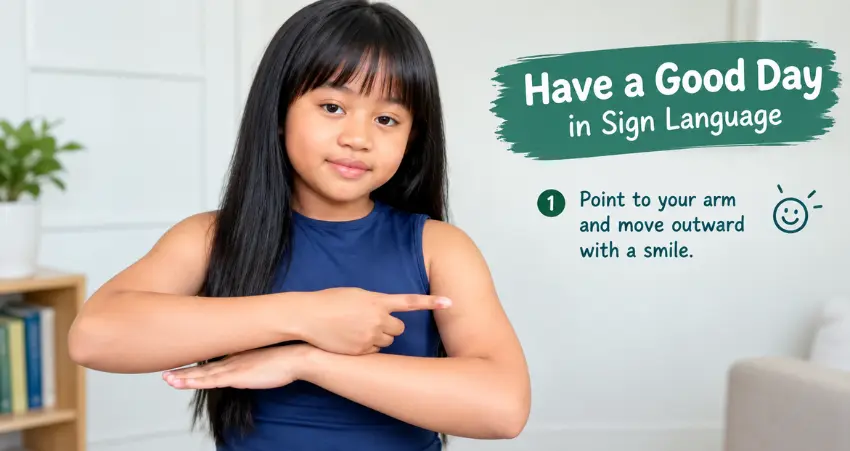
Step 2: Sign “DAY”
The ASL sign for DAY represents the movement of daylight across the horizon.
Hold your non-dominant arm horizontally in front of your body.
Place your dominant arm above it.
Your dominant arm moves downward toward the non-dominant arm.
The movement represents the sun moving across the sky and toward the horizon.
Practice the movement slowly at first. Once you become comfortable, make the sign naturally rather than exaggerating the motion.
“Have a Good Day” ASL Sign Breakdown
English | ASL Concept |
|---|---|
Have a Good Day | GOOD + DAY |
Good | GOOD |
Day | DAY |
Goodbye | Often expressed with a natural goodbye sign or context |
Remember that ASL is not English performed with the hands. Its grammar and sentence structure are different from spoken English. Because of this, a direct word-for-word translation may not always be the most natural way to communicate an English expression.
When to Use “Have a Good Day” in ASL
“Have a Good Day” is a friendly expression that can be used in many everyday situations.
Saying Goodbye
You can use the expression when ending a conversation with someone.
For example, after talking with a friend, coworker, teacher, or neighbor, you can sign GOOD + DAY as a friendly way to wish them well.
At Work
The phrase can be useful when leaving work or saying goodbye to a colleague. It is especially natural in situations where you want to leave on a positive note.
At School
Students can use the expression with classmates, teachers, or other people at school.
Meeting Someone
If you are meeting someone earlier in the day and want to wish them well, the signs can also be used depending on the conversation and context.
Everyday Conversations
You do not need a special occasion to use this expression. Like its English equivalent, it can be used as a simple, polite way of wishing somebody a pleasant day.
Why Learn “Have a Good Day” in ASL?
Learning individual signs is useful, but learning complete everyday expressions can make your ASL practice more practical.
Here are a few reasons to learn this phrase:
It is useful in everyday conversations.
The signs are relatively simple for beginners.
It helps build your basic ASL vocabulary.
You can practice it with friends or family.
It gives you an opportunity to work on facial expressions and natural movement.
It can help you become more comfortable communicating with Deaf and hard-of-hearing people.
Starting with common phrases can also make learning ASL feel less overwhelming.
Is “Have a Good Day” One Sign in ASL?
No single sign always represents the entire English phrase “Have a Good Day.”
ASL frequently communicates concepts rather than translating each English word individually. In this case, a signer may use GOOD and DAY together to communicate the intended message.
The exact signs and structure can also vary according to the situation, the signer, and the surrounding conversation.
This is an important point for beginners: ASL should be learned as a language, not simply as a collection of English words represented by hand movements.
Facial Expressions Matter in ASL
Your hands are only one part of ASL communication. Facial expressions and body language can also affect how a message is understood.
When signing a friendly expression such as “Have a Good Day,” use a natural and pleasant facial expression. You do not need to make an exaggerated face. A relaxed expression and appropriate eye contact can make your signing look much more natural.
As you become more experienced, pay attention to:
Facial expressions
Eye contact
Body position
Hand orientation
Movement speed
Location of the signs
Transitions between signs
These details can make a noticeable difference when practicing ASL.
Common Mistakes Beginners Make
Learning ASL takes practice, and beginners often make a few common mistakes.
Translating Every English Word
One of the biggest mistakes is assuming that every English word needs its own separate sign.
English and ASL have different structures. Instead of trying to translate English word by word, focus on the meaning you want to communicate.
Moving Too Quickly
New learners sometimes rush through signs because they are trying to remember the entire phrase. Start slowly and focus on making each sign correctly.
Ignoring Hand Orientation
The direction your palm faces and the position of your fingers can be important. Watch demonstrations carefully and copy the handshape and movement.
Forgetting Facial Expressions
ASL is more than hand movements. Facial expressions and body language are important parts of natural communication.
Practicing Without Checking Your Form
It is easy to develop incorrect movements when practicing from memory. Use reliable visual resources and compare your signing with demonstrations from experienced ASL users.
How to Practice “Have a Good Day” in ASL
You do not need to spend hours practicing one phrase. A few minutes of focused practice can be useful.
Start by practicing GOOD separately. Repeat the movement several times until it feels comfortable.
Next, practice DAY. Pay attention to the position of both arms and the direction of the dominant hand.
Then combine them:
GOOD → DAY
Repeat the complete expression several times while keeping your movements smooth.
You can also practice the phrase in different situations. For example, imagine that you are leaving a store, finishing a conversation with a friend, or saying goodbye to a coworker. This helps connect the signs with real communication rather than simply memorizing movements.
Learn ASL With a Sign Language Translator
A sign language translator can be a helpful learning tool when you are building your vocabulary. Instead of searching for every individual word manually, you can enter a word or phrase and use visual results to explore related signs.
For example, SLTranslator.com allows users to enter text and view sign-language representations. It can be useful for practicing letters, words, and common expressions while learning sign language.
You can enter words such as:
Good
Day
Hello
Goodbye
Thank you
Please
Help
Friend
Family
Love
A translator can make it easier to explore new vocabulary, but it should be used as a learning aid rather than as a replacement for learning ASL grammar and communicating with experienced signers.
Learn More Than Individual Signs
Once you know how to sign “Have a Good Day,” continue building your vocabulary with other common expressions.
Some useful beginner phrases include:
Hello
HELLO is one of the first signs many ASL learners practice. It is useful when starting a conversation.
Thank You
THANK YOU is another essential expression for everyday communication.
Please
Learning PLEASE gives you another polite expression that can be used in many situations.
How Are You?
This is a common conversational question and can help you move beyond individual vocabulary words into short conversations.
See You Later
Learning goodbye-related expressions can help you naturally finish conversations.
By learning groups of related phrases, you can gradually build a more practical ASL vocabulary.
“Have a Good Day” vs. “Good Day”
The expressions “Good Day” and “Have a Good Day” can have similar meanings in certain situations, but they are not necessarily interchangeable in every context.
“Good Day” can function as a greeting or a general expression, depending on the situation.
“Have a Good Day” is generally used as a positive wish, especially when ending an interaction.
In ASL, context plays an important role. A signer may express the intended meaning without following the exact English sentence structure.
Can You Use ASL for Everyday Communication?
Absolutely. ASL is used for everyday communication, including conversations about family, school, work, hobbies, shopping, travel, food, entertainment, and many other subjects.
If you are learning ASL, focus on useful vocabulary rather than trying to memorize hundreds of isolated signs at once.
A practical beginner learning path could look like this:
Learn the ASL alphabet.
Practice numbers.
Learn greetings.
Learn common everyday words.
Practice simple questions.
Learn useful phrases.
Study basic ASL grammar.
Watch native or experienced ASL signers.
Practice with other people.
Use visual tools to review vocabulary.
Learn the ASL Alphabet Too
The ASL alphabet, also called fingerspelling, is an important part of learning American Sign Language.
Fingerspelling allows you to spell words letter by letter. It can be particularly useful for names, places, technical terms, and words for which you do not know the sign.
Learning the alphabet also helps you become familiar with different handshapes.
However, fingerspelling is only one part of ASL. Becoming comfortable with the alphabet does not mean you have learned the entire language. Continue learning signs, grammar, facial expressions, and conversational skills.
How Long Does It Take to Learn ASL?
There is no fixed amount of time required to learn ASL. Your progress depends on how often you practice, how you learn, and how much real communication you experience.
Someone who practices a few minutes every day may gradually build a useful vocabulary. Regular interaction with other ASL users can provide additional opportunities to improve.
Instead of focusing only on how quickly you can become fluent, create small goals.
For example:
Week 1: Learn the alphabet and basic greetings.
Week 2: Add numbers and common everyday words.
Week 3: Practice short phrases.
Week 4: Start combining signs and working on conversational skills.
The important thing is consistent practice.
Tips for Learning ASL Online
Online resources make it easier to practice ASL from home. However, choose resources carefully and pay attention to the person demonstrating each sign.
Here are some useful tips:
Watch the Entire Movement
Do not focus only on the handshape. Watch where the sign starts, how it moves, and where it finishes.
Practice in a Mirror
A mirror can help you check your hand position and movement.
Record Yourself
Recording yourself signing can make it easier to notice movements that need improvement.
Practice Regularly
Ten minutes of daily practice can be more useful than practicing for a long session once a month.
Learn From Deaf ASL Users
Whenever possible, learn from Deaf people and experienced ASL signers. Their use of natural language, facial expressions, and conversational style can help you understand how ASL is actually used.
Frequently Asked Questions
How do you say “Have a Good Day” in American Sign Language?
A common way to express the idea is by signing GOOD + DAY. ASL does not always translate English phrases word for word, so the exact structure can depend on context.
Is there a single ASL sign for “Have a Good Day”?
The English phrase does not necessarily correspond to one single ASL sign. The concepts GOOD and DAY can be combined to express the intended message.
Is “Have a Good Day” easy to learn in ASL?
Yes. The individual signs are useful beginner vocabulary, although correct handshape, movement, orientation, and natural expression still require practice.
Can I learn ASL online?
Yes. You can learn vocabulary, fingerspelling, basic grammar, and common expressions through online resources. For stronger conversational skills, practice with experienced ASL users whenever possible.
Can a sign language translator help me learn ASL?
Yes. A sign language translator can help you explore vocabulary and visualize signs. It works best as one part of a broader learning routine that includes grammar, videos, practice, and interaction with ASL users.
Is ASL the same as English?
No. American Sign Language is a complete natural language with its own grammar and structure. It is not simply English translated into hand movements.
Final Thoughts
Learning how to express “Have a Good Day” in American Sign Language is a small but useful step toward building your ASL vocabulary. Start with the concepts GOOD and DAY, practice each movement carefully, and then combine them naturally. Remember that successful ASL communication involves much more than hand movements. Facial expressions, body language, eye contact, hand orientation, and context all contribute to the message.
If you are just beginning, keep practicing common expressions and everyday vocabulary. An online sign language translator such as SLTranslator.com can also help you explore new words and practice visual signs. With regular practice and exposure to natural ASL, you can continue expanding your communication skills one sign at a time.