
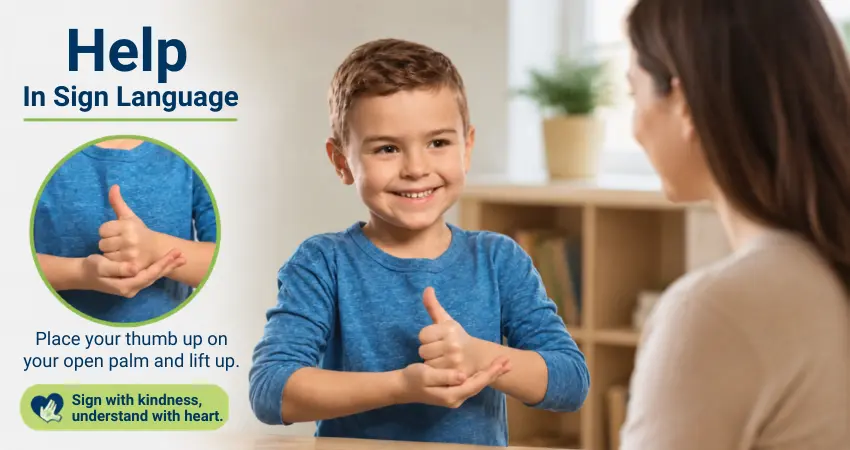
To sign help in American Sign Language (ASL), make a “thumbs-up” shape with your dominant hand and place it on the palm of your open, non-dominant hand. Move both hands upward together. Since it is a directional sign, you can move it toward yourself for “help me” or toward someone else to “help.
Learn All common sign language words at our site. We provide hand thumb sign images.
The sign at a glance
Everything you need to check your form in five seconds.
Handshape: A-hand (thumbs-up fist) on flat palm
Movement: Both hands lift upward together
Location: Neutral space, chest height
Palm orientation: Base palm faces up throughout
STEP BY STEP
How to form the sign
HELP is a two-handed sign, and the order you build it in matters.
- Form your handsMake a thumbs-up (A-handshape) with your dominant hand. Hold your non-dominant hand flat and open, palm facing up.
- Rest the fist on the palmPlace your dominant fist, thumb pointing up, directly on the center of your flat palm — like your palm is a small platform.
- Lift both hands togetherRaise both hands upward in one smooth motion, as if you’re physically lifting or boosting something into the air. The fist never leaves the palm.
- Add direction and expressionMove the whole sign toward the person you’re helping, or pull it toward your own chest to mean “help me.” Raise your eyebrows to turn it into a question.
DIRECTIONAL VERB
HELP changes direction, not shape
ASL uses space grammatically. The handshape for HELP never changes — only where you move it and who it moves toward.
Offering help
“I’ll help you”
Form the sign in front of your chest, then move it outward toward the person you’re offering to help.
Requesting help
“Help me”
Form the sign further out, then pull it inward toward your own chest to indicate the help is directed at you.
Asking a question
“Do you need help?”
Sign HELP toward the other person while raising your eyebrows and tilting your head slightly — no separate question sign needed.
IN CONTEXT
Common phrases that use HELP
| English | How it’s signed |
|---|---|
| Help! | Sharp, quick movement with an urgent facial expression for emergencies. |
| Can you help me? | HELP signed toward yourself, with raised eyebrows for the question. |
| I helped my friend | HELP moved toward where the friend was positioned, past tense shown by context or a time sign. |
| Thanks for your help | HELP followed by the sign for THANK-YOU, directed at the helper. |
| I don’t need help | HELP paired with a headshake or the NOT-NEED sign for negation. |
TROUBLESHOOTING
Mistakes worth fixing early
✕ Common mistake
Signing with only the dominant fist and skipping the flat palm underneath. Without the base hand, the sign reads as incomplete or unclear.
✓ Correct form
Always keep the non-dominant hand flat and open beneath the fist — it represents what’s being lifted or supported.
✕ Common mistake
Confusing HELP with SUPPORT, which uses two stacked fists instead of a fist on a flat palm.
✓ Correct form
Check your base hand: flat and open means HELP; a second fist means SUPPORT. Same upward motion, different handshape.
Frequently asked questions
What is the sign for HELP in ASL?
The ASL sign for HELP uses a thumbs-up fist resting on a flat, upward-facing palm. Both hands lift together in one motion, as if physically raising or supporting something.
Is the HELP sign directional?
Yes. HELP is a directional verb. Move the sign toward the person receiving help to say “I’ll help you,” or move it toward yourself to say “help me.” The handshape stays the same — only the direction changes.
How do you ask “do you need help?” in sign language?
Sign HELP while raising your eyebrows and tilting your head slightly forward. The raised eyebrows are a non-manual marker that turns the statement into a yes/no question.
What’s the difference between HELP and SUPPORT in ASL?
HELP uses a lifting motion with a thumbs-up fist on a flat palm. SUPPORT uses two fists stacked and pushed upward together, without the flat palm underneath.
Can HELP be signed with one hand?
No. HELP is a two-handed sign. Signing it with only the dominant hand and no flat palm underneath is one of the most common mistakes learners make.
See HELP and thousands of other signs translated live. SLTranslator turns text into sign language animations in real time, free, right in your browser. Open the sign language translator →