
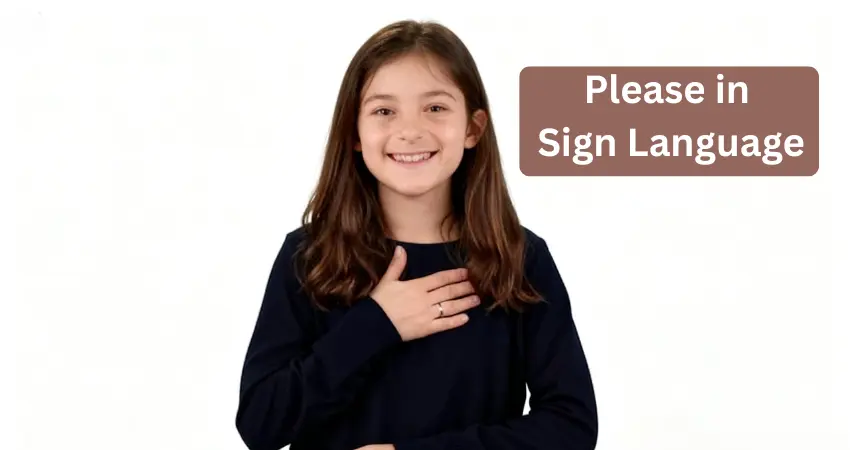
In American Sign Language, PLEASE is one of the very first signs taught to children, students, and anyone beginning their ASL journey. It is simple to execute and deeply meaningful — expressing gratitude, courtesy, and warmth without a single spoken word.
Unlike many ASL signs that require precise handshapes, PLEASE uses a natural, relaxed open hand — making it accessible even for people with limited hand dexterity.
Learn popular daily use sign language words at our site. We provide hand thumb sign images.
How to Sign Please – 4 Easy Steps
Follow these four steps, and you’ll be signing PLEASE confidently within minutes.
1. Open Your Hand
Flatten your dominant hand — fingers together, thumb relaxed, palm facing your body.
2. Place on the chest
Rest your open palm flat against the center of your chest, fingers pointing sideways.
3. Rub Clockwise
Gently rub your hand in a smooth circular motion (clockwise as seen from the front).
4. Add Expression
Keep your face warm and sincere; facial expression is grammar in ASL.
Tips for Signing PLEASE Correctly
These tips will help you sign PLEASE naturally and communicate more effectively in American Sign Language.
- ✋ Use your dominant hand only. If you’re right-handed, always use your right hand. Consistency is important in ASL communication.
- 😊 Facial expression matters. A warm, sincere face reinforces the meaning of PLEASE. In ASL, your face is part of the grammar — not just decoration.
- 🔄 Keep the motion smooth and relaxed. A gentle, fluid circular rub feels natural. Avoid stiff or fast movements they can change the meaning or feel aggressive.
- 📍 Place your hand on your chest, not your stomach. The sign is performed on the upper chest. Placing it too low may create confusion with other signs.
- 🎯 Practice in front of a mirror. Watching yourself sign helps catch errors in hand placement, motion direction, and facial expression.
Using PLEASE in ASL Sentences
PLEASE HELP ME
Sign PLEASE → HELP → ME to ask politely for assistance.
WATER PLEASE
Sign WATER → PLEASE to request a drink politely.
SIT PLEASE
Sign SIT → PLEASE to politely ask someone to sit down.
PLEASE WAIT
Sign PLEASE → WAIT to ask someone to hold on.
How to Learn Sign Language?
Learning sign language is easier than it looks if you stay consistent. Start with the basics like the alphabet and common words, using free apps or videos. Practice daily, even for 10–15 minutes, and try to use signs in real conversations if possible. Watching videos and mimicking hand movements helps a lot. You can also join online classes or visit a sign language translator to improve faster.
FAQ
Frequently Asked Questions
How do you say please in sign language?
In ASL, place your open, flat dominant hand on your chest and rub it in a circular motion. Your palm should face your body, and your expression should be warm and sincere.
Is the PLEASE sign the same in all sign languages?
No, sign languages are distinct languages unique to each country and region. The PLEASE sign described here is for American Sign Language (ASL). BSL, Auslan, and others all use different signs for the same concept.
Which hand do I use for the PLEASE sign?
Always use your dominant hand, right hand for right-handed signers, left hand for left-handed. This is consistent across nearly all ASL signs.
Can babies learn the sign for PLEASE?
Yes! Baby sign language uses simplified versions of ASL signs. PLEASE is one of the most commonly taught baby signs because the motion is natural and easy for small hands. Babies as young as 6–9 months can begin learning it.
What is the difference between PLEASE and THANK YOU in ASL?
Please use a circular rub on the chest. THANK YOU moves a flat hand from near the mouth/chin outward toward the person you’re thanking, like blowing a kiss of gratitude. Both use an open, flat hand, but in different locations and motions.
Do I need to mouth the word please while signing?
In ASL, mouthing words (called “mouthing”) is optional and depends on context. Many signers do mouth words simultaneously, especially in educational or mixed hearing/Deaf environments. It’s not required, but it can add clarity for lip-readers.