
Whether you’re a parent teaching your baby, a student studying ASL, a healthcare worker, or simply someone who wants to connect with the Deaf and Hard-of-Hearing community, knowing how to sign Thank You is the perfect place to start.
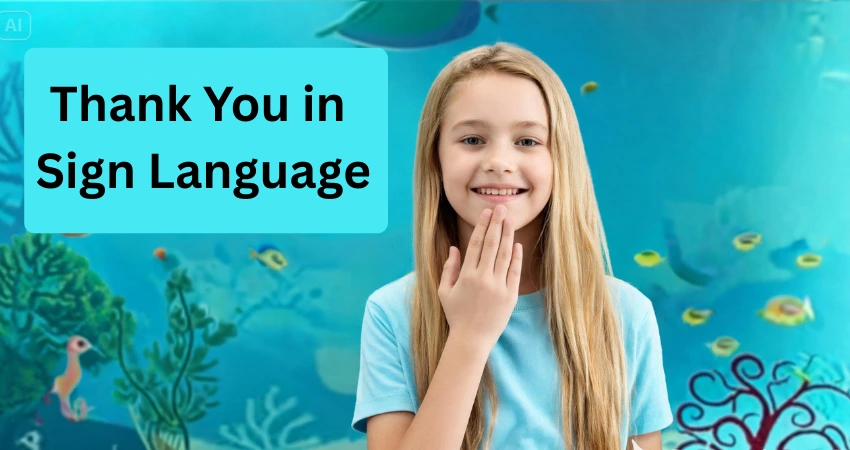
The ASL sign for Thank You is one of the easiest and most universally recognized signs. It mimics the natural gesture of gratitude that many cultures already use, touching the hand to the face and moving it outward. Anyone can learn it from the educational sites or a sign language translator.
Step-by-Step: How to Sign Thank You in ASL
Three simple movements, anyone can do them in minutes.
🖐️ Flatten your dominant hand
Hold your dominant hand (right hand for most people) flat with all fingers together, and your thumb relaxed outward. Think of it like a gentle, open salute.
💡 Tip: Your palm should face inward toward your face, not downward.
👄 Touch your fingertips to your chin
Bring the fingertips of your flat hand to your chin (some signers touch just below their lips). This is the starting position. Keep your hand relaxed and natural.
💡 Tip: Chin or lips both are correct. The Deaf community accepts either variation.
➡️ Move your hand forward and downward
Smoothly bring your hand away from your chin in a forward and slightly downward arc — as if you’re sending gratitude out toward the person you’re thanking. The motion should feel warm and natural, like a gentle bow of the hand.
💡 Tip: The movement is one smooth arc, not two separate parts. Practice until it flows naturally.
Pro Tips for a Natural Sign
Small details that make a big difference in authenticity.
😊 Use facial expressions
In ASL, the face is grammar. A warm smile paired with the Thank You sign reinforces your sincere gratitude.
🎯 Keep it fluid
Don’t make the motion too stiff or robotic. Practice in front of a mirror until the arc feels natural and smooth.
🔁 Don’t repeat it
Unlike some ASL signs, Thank You is performed once, not twice. Repeating it could change the meaning or look awkward.
📏 Adjust your distance
When signing to someone across the room, make the sign slightly larger and more deliberate so it’s clearly visible.
🤝 Eye contact matters
Always maintain eye contact when signing. Looking away signals disengagement and can be considered rude in Deaf culture.
🧠 Practice daily
Use it every time you’d naturally say “thank you” in your day. Muscle memory builds fast with real-life repetition.
Common Mistakes to Avoid
These small errors are easy to fix once you know what to look for.
| ❌ Common mistake | ✅ Do this instead |
| Curling or bending fingers | Keep fingers flat and together |
| Starting from the forehead | Start from the chin or lips only |
| Moving hand sideways | Move forward and slightly down |
| No facial expression | Smile expression is part of ASL grammar |
| Performing the sign twice | One smooth motion is correct |
Thank You Around the World in Sign Language
Every country has its own sign language. Here’s how gratitude looks globally.
ASL (USA & Canada)
Flat hand from the chin, moving forward. The most widely taught version internationally.
BSL (British)
A slight bow of the head combined with a forward hand motion. More subtle than ASL.
Auslan (Australia)
Very similar to BSL Australia’s sign language, descended from British Sign Language.
International Sign
A simplified gesture used at global Deaf events is typically a nod with open hands forward.
Frequently Asked Questions
Everything people commonly ask about signing Thank You.
How do you say thank you in sign language?
In American Sign Language (ASL), touch the fingertips of your flat, dominant hand to your chin, then move it forward and slightly downward in one smooth arc. It resembles blowing a grateful kiss toward the person you’re thanking.
Is thank you the same as you’re welcome in ASL?
Yes, the hand motion is identical! What separates them is context, facial expression, and whose turn it is in the conversation. After someone signs Thank You to you, signing it back means You’re welcome.
Can babies learn to sign thank you?
Absolutely! Baby sign language is widely endorsed by pediatricians. Infants as young as 6–8 months can begin learning simple signs. Thank You is a top pick for early learning because of its simplicity and importance in social development. It also helps babies communicate before they can speak.
Where can I practice ASL with real people?
Look for local Deaf community events, ASL Deaf coffee chats, or meetups organized by organizations like the National Association of the Deaf (NAD). Online platforms like ASLdeafined, Signing Savvy, and YouTube channels run by Deaf educators are also excellent resources.
Learn All common and mostly use sign language words at our site. We provide hand thumb sign images.