
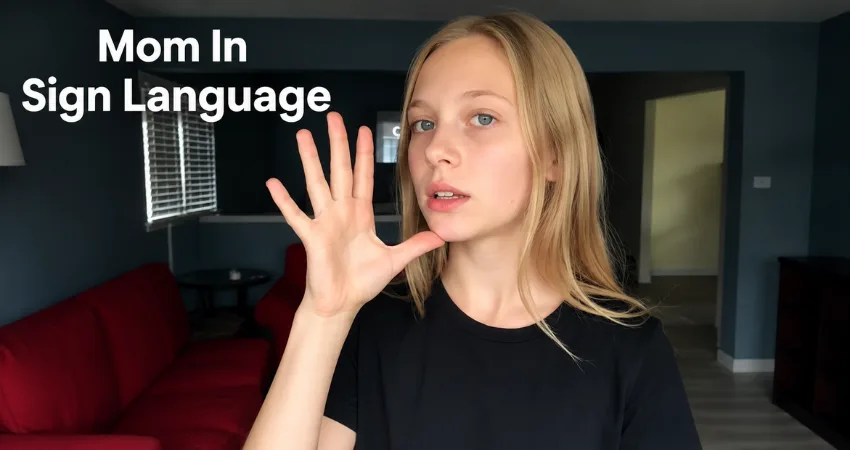
MOM is one of the very first signs Deaf and hearing families teach a baby — open hand, thumb to chin, done. Here’s exactly how to form it correctly, how it differs from MOTHER and DAD, and a full roadmap for learning sign language beyond a single word.
Quick Answer
The sign for MOM, in three parts
- Handshape — an open hand with your fingers spread, the “5” handshape.
- Location — your thumb touches the center of your chin.
- Movement — tap once. A second tap is common, not required.
Same hand, same motion, at the forehead instead of the chin — that’s DAD.
01. The Sign for MOM, Step by Step
This is the standard sign taught in most American Sign Language (ASL) courses and used throughout the Deaf community across the United States and English-speaking Canada. ASL is a complete, independent language with its own grammar, it isn’t English translated into gestures, so treat each sign as a real word, not a mime.
- Shape your hand. Hold your dominant hand open with your fingers naturally spread apart, the way you’d hold up a “5” when counting. ASL instructors call this the open “5” handshape.
- Find your chin. Bring your thumb to the center of your chin. Your palm should face roughly toward your own face, not out toward the person you’re talking to.
- Make contact. Tap your thumb against your chin once, keeping your fingers loose and spread, not stiff.
- Tap again, if it feels natural. A single tap already means MOM. Many signers add a second tap, which is common but not required.
- Keep your expression natural. MOM doesn’t carry a specific facial grammar marker, but sign conversation always carries some meaning in the face, so don’t sign with a blank stare.
Inside the SignHandshapeOpen 5 hand, fingers spread, thumb freeLocationCenter of the chinMovementThumb taps the chin once, sometimes twicePalm orientationFacing inward, toward the signerNon-manual signalNone required , neutral or warm expressionRelated signDAD, identical, but at the forehead
Sign linguists break every sign into these same building blocks handshape, location, movement, and orientation. Change just one of them, and you change, or break, the meaning.
02. MOM vs. MOTHER vs. MAMA
In ASL, MOM and MOTHER are usually the exact same sign. What changes is mouthing — the shape your mouth makes while you sign — and context, the same way choosing the word “mom” over “mother” in English is about tone and formality, not a different fact. Some signers reserve a slightly different version, a fluttering motion near the cheek, for more formal or compound uses such as MOTHER-EARTH, but that’s a variant you’ll encounter rather than the version you need first.
MAMA and MOMMY work a little differently. Many Deaf parents simplify the adult sign for very young children, sometimes tapping the chin with just the index finger instead of the full open hand — a natural simplification, similar to how a hearing toddler says “mama” before graduating to “mother.” Babies often approximate the motion loosely at first, and that’s expected in sign language the same way it is in spoken language.
Like English, ASL has regional, generational, and family variation. If a sign you learn online looks slightly different from how someone in your life signs it, that doesn’t make either version “wrong” — ask the person you’re signing with which version they prefer.
03. Common Mix-Ups to Avoid
- Chin vs. forehead. MOM and DAD use the identical handshape and motion — only the location changes. Many ASL classes point out a broader pattern here: kinship signs for women tend to sit lower on the face, near the chin or jaw (MOM, GIRL), while signs for men tend to sit higher, near the forehead (DAD, BOY). Once you notice it, it’s hard to mix up again.
- Losing the handshape. Curling your fingers into a fist or pinching them together changes, or erases, the sign. Keep the hand open and the fingers spread the entire time.
- Tapping the wrong spot. Drifting up toward the cheek or mouth can blur MOM with other signs that live in that same neighborhood of the face. Aim for the center of the chin.
- Fingerspelling instead of signing. Spelling M-O-M letter by letter is understood, but it isn’t how fluent signers say “mom” — it’s the sign-language equivalent of spelling out “y-e-s” instead of nodding.
04. Mom in Other Sign Languages
There is no single global sign language. Each one is a distinct, naturally evolved language tied to its own Deaf community, not a translation of the local spoken language, so MOM doesn’t look the same everywhere.
In British Sign Language (BSL), for example, the common sign for MUM or MOTHER fingerspells the letter M with the dominant hand and taps it on the open palm of the other hand, twice. A widely used alternative taps that same M handshape against the temple instead. Because the motion is identical to the BSL sign for MONDAY, signers rely on mouthing the word to tell the two apart a good reminder that mouth movement is doing real grammatical work in sign languages, not just decoration.
Beyond ASL and BSL, sign languages such as Auslan (Australia), LSF (France), and dozens of others each have their own sign for “mom,” shaped by their own history rather than by ASL or English. If you’re learning a sign language other than ASL, look it up in a dictionary built for that specific language rather than assuming the ASL version above will transfer. International Sign, a simplified system used at international Deaf events, isn’t a substitute for any country’s national sign language either it’s a contact tool, not a native language.
05. Teaching Baby Sign Language for “Mom”
Baby sign language programs almost always borrow this exact ASL sign rather than inventing a separate one, because it’s already about as simple and visible as a sign gets: one hand, one obvious target, one motion. Babies typically begin imitating it somewhere around 6 to 9 months, often before they can say the word out loud, since the muscles that control hand movement develop ahead of the fine motor control speech requires.
A few practical tips: sign MOM on yourself every time you say the word “mom” out loud — consistency and repetition matter far more than precision at this age. Hold the sign briefly so your baby has time to actually see it. And don’t worry if their early attempts are a loose pat near the face rather than a clean tap on the chin; that approximation is a normal stage, not a mistake to correct.
06. How to Learn Sign Language: A Roadmap
Knowing one sign is a nice start. Here’s the order that actually works for learning the language behind it.
- Start with fingerspelling, not vocabulary lists. The manual alphabet is only 26 handshapes, and it instantly unlocks names, places, and any word that doesn’t have a dedicated sign yet. Most ASL courses teach it in lesson one for exactly this reason.
- Build vocabulary by topic, not at random. Family, food, feelings, numbers, question words, and everyday classroom or workplace basics give you usable building blocks fast, instead of a long list you’ll forget by next week.
- Learn grammar early, alongside vocabulary. ASL word order, classifiers, and non-manual markers — like the eyebrow raise that turns a sentence into a yes/no question — aren’t an advanced add-on. They’re how the language actually works, from sentence one.
- Watch native signers daily. Deaf vloggers, ASL storytelling, and Deaf-hosted shows teach you the rhythm and natural movement a vocabulary list never will. A little exposure every day beats a lot once a week.
- Practice expressively, not just receptively. Recording yourself signing and comparing it to a native model catches habits, a wandering handshape, a missing facial marker, that you’d never notice just by watching.
- Get into real conversation as early as you can. A Deaf coffee chat, an ASL club, or a campus Deaf studies event will move you faster than months of solo study, because sign language, like any language, is for connecting with people, not for collecting flashcards.
- Show up consistently. Sign language has a real motor-skill component, closer to learning an instrument than memorizing vocabulary. Twenty minutes a day for a month beats one four-hour binge.
07. Where to Actually Learn It
Free and self-paced
- ASL University (Lifeprint), built by ASL professor Dr. Bill Vicars — free lessons, quizzes, and printable materials from absolute beginner through advanced.
- SignSchool — free structured video lessons with grammar notes and small interactive games.
- Signing Savvy — a searchable video dictionary that’s handy once you already know roughly what you’re looking for.
- Sign Language Translator – Practice your language skills for free with exercise and translation.
Apps for daily practice
- The ASL App and Lingvano for short daily lessons and phrase practice you can do from a phone.
- Apps that use video feedback or 3D hand models, where you can record yourself and compare, are especially good at catching handshape mistakes early.
Structured and in-person
- Gallaudet University, the world’s only university built specifically around Deaf education and bilingual ASL/English instruction, offers courses beyond its own student body too.
- Many community colleges teach ASL for foreign-language credit — look for instructors with ASLTA (American Sign Language Teachers Association) certification.
Community and immersion
- Local “Deaf coffee chat” socials, ASL clubs, and events hosted by Deaf-led organizations such as the National Association of the Deaf (NAD) are where vocabulary turns into a real language.
- The Deaf community’s own guidance is consistent on this point: learning directly from Deaf teachers, not only from hearing-taught material, is widely considered the most respectful and most effective path. You’re learning a living language from the people whose language it is.
Frequently Asked Questions
Is the sign for “mom” the same as “mother” in ASL?
Yes, in almost every everyday context — same handshape, same location, same movement. The difference between “mom” and “mother” lives in mouthing and context, exactly like the difference between those two words in English.
What is the baby sign language sign for “mom”?
It’s the same ASL sign — open hand, thumb to chin. Baby sign language programs don’t usually create separate simplified signs; this one is already simple enough for an infant to copy.
How do you remember mom vs. dad in sign language?
Both use the identical open-hand shape; only the location changes — chin for MOM, forehead for DAD. It helps that ASL has a broader pattern where signs tied to women tend to sit lower on the face and signs tied to men tend to sit higher.
Is the sign for “mom” the same in every country?
No. Sign languages are independent languages, each shaped by its own Deaf community’s history, not by the local spoken language. British Sign Language, for instance, signs “mum” with a completely different handshape than ASL does.
How long does it take to learn sign language?
It varies as much as learning any spoken language does. With regular daily practice, many learners reach basic conversational ability within several months to a year; real fluency develops fastest through ongoing contact with Deaf signers, not solo study alone.
What’s the fastest way to start learning sign language on your own?
Learn the fingerspelling alphabet first, build vocabulary by everyday topic instead of random lists, watch native signers daily, and get into real conversation with Deaf signers as soon as possible — speed comes from consistency and real use, not a single trick.
Try It Now
Open your hand. Spread your fingers. Find your chin. Tap once.
That’s MOM — you just signed your first word.
Learn All popular sign language words at our site. We provide hand thumb sign images.