
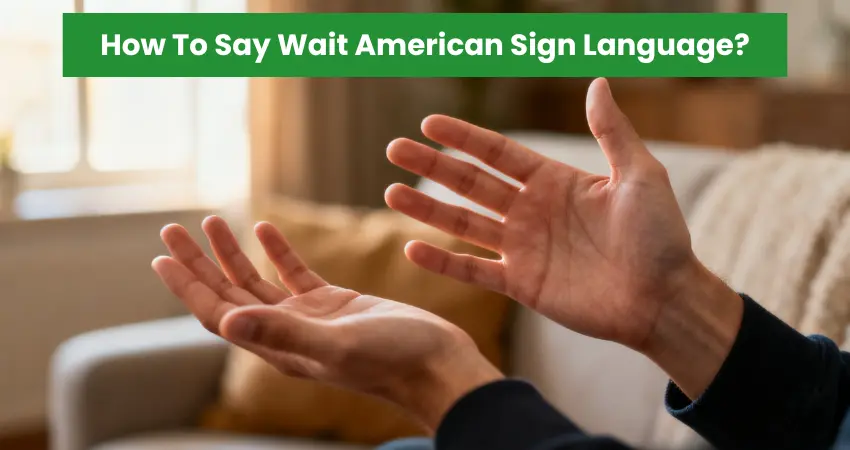
To sign WAIT in ASL: raise both hands to chest level with palms facing you, spread all fingers wide (the “5 handshape”), then gently wiggle your fingers back and forth — like you’re softly playing piano keys in mid-air.
Step-by-Step: How to Sign WAIT in ASL
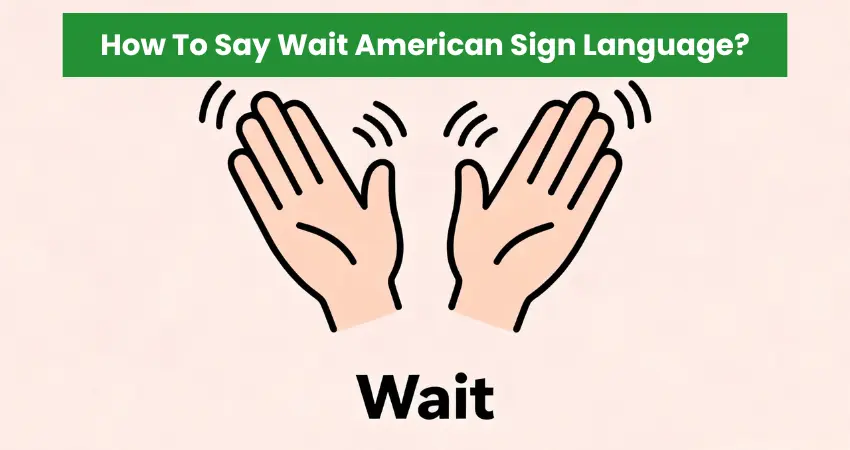
Follow these three simple steps to sign WAIT clearly and correctly in American Sign Language.
1. 🙌 Raise Both Hands to Chest Level
Bring both hands up in front of your chest, roughly between your chin and waist. Keep them comfortably in front of your body, not pressed against it.
2. 🖐️ Form the 5 Handshape with Palms Facing You
Spread all five fingers wide on both hands — this is called the “5 handshape” in ASL. Your palms face toward your body (inward), with fingers pointing upward.
3. ✨Gently Wiggle Your Fingers
While holding the position, gently wiggle all your fingers at the same time. The movement should be soft and relaxed, imagine your fingers rippling like you’re waiting around and idly tapping the air.
ASL Pronunciation Breakdown
In ASL linguistics, every sign has four phonological parameters. Here’s what WAIT looks like:
| Parameter | Description |
|---|---|
| Handshape | Two “5 hands” — all five fingers spread wide on both hands |
| Location | Mid-space in front of the body, around chest level |
| Orientation | Palms facing inward (toward the signer’s body) |
| Movement | All fingers wiggle simultaneously — soft, gentle motion |
Memory Trick: Never Forget This Sign
💡 Memory Tip
The WAIT sign looks exactly like what you do when you’re waiting around with nothing to do gently wiggling your fingers, perhaps tapping your hands in the air out of boredom. The movement visually captures that feeling of anticipation and patience, making it one of the most intuitive signs for beginners to remember.
Think of it this way: when someone is waiting, they often fidget. The sign mirrors that natural fidgeting motion, fingers wiggling in the air. This is the visual, iconic nature of ASL at its best. You can also practice your vocabulary with an ASL sign language translator.
When to Use the ASL Sign for WAIT
The WAIT sign is incredibly versatile in everyday ASL conversations. Here are common real-life contexts:
📞 Please wait
When you’re on the phone and need to hold on while someone else needs your attention.
🧒 Classroom management
Teachers sign WAIT to students who need attention while they’re working with another child.
🚶 Waiting in line
Tell someone to be patient and stay put while waiting in a queue.
⏳ “He was waiting for you.”
Describe someone who remained in place, expecting another person to arrive.
👨👧 Parent-child communication
Cue children to wait patiently without interrupting an adult conversation.
🗣️ Hold on a moment
Ask someone to pause briefly before continuing a conversation or action.
ASL Variations of the WAIT Sign
Skilled Deaf signers inflect the WAIT sign to express different shades of meaning, just like English has wait, waiting, and long-waited.
WAIT
- Standard sign, fingers wiggle while hands are held stationary in front of the body.
WAIT-LONG
- Fingers wiggle while the hands also move in a slow circular or oval motion — conveying “waiting for a very long time.”
WAIT-SO-LONG
- An exaggerated form with added facial expression (mouth morpheme “th”) to emphasize frustration or exhaustion from waiting.
Frequently Asked Questions
Common questions beginners have about the ASL sign for WAIT:
How do you say “wait” in American Sign Language?
To sign WAIT in ASL, hold both hands at chest level in front of you with palms facing your body. Spread all five fingers wide (the “5 handshape”) and gently wiggle your fingers. That’s it — three easy steps!
What does the “5 handshape” mean in ASL?
The “5 handshape” in ASL simply means all five fingers are spread wide open — like the number five. It’s one of the most common handshapes used in ASL and appears in many different signs.
Is the WAIT sign the same in all sign languages?
No, ASL (American Sign Language) and other sign languages like BSL (British Sign Language), Auslan (Australian), or ISL (International) are completely different languages. The WAIT sign described here is specific to American Sign Language.
Can I use one hand instead of two for the WAIT sign?
The standard ASL sign for WAIT uses two hands. While some regional variations exist, using both hands as described ensures clarity and is understood widely by the Deaf community.
Is ASL hard to learn for beginners?
ASL is a rich, full language, but many individual signs, like WAIT, are straightforward and intuitive for beginners. Starting with common everyday signs is the best way to build vocabulary quickly. Many signs are iconic, meaning they visually resemble their meaning.
What are the related signs I should learn alongside WAIT?
After learning WAIT, consider also learning: STOP, PAUSE, PLEASE, PATIENT, HURRY, and NOW. These signs often appear in similar conversational contexts and will greatly expand your practical ASL vocabulary.
Explore Related ASL Signs
Explore sign language words:
🤚 Stop⏸️ Pause🙏 Please😌 Patient⚡ Hurry🕐 Now🔜 Later✅ Ready👀 Watch👋 Hello
Start Learning ASL Today — For Free
WAIT is just one of thousands of ASL signs. Explore our full beginner dictionary, video tutorials, and interactive quizzes to build real fluency. Learn All sign language words necessary for daily life at our site. We provide hand thumb sign images.